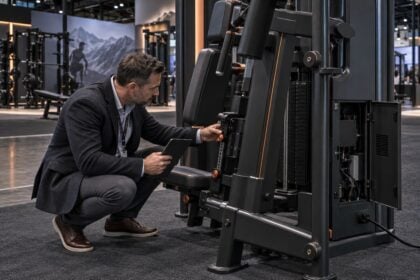

A treadmill stops mid-session at twenty past six in the morning, and every judgment a member will form about gym equipment support at your facility is made in the following day. Not in the repair, which they never see, but in the first hour on the floor and the first honest sentence anyone says to them.
- Hour Zero: Stop the Machine, Not the Floor
- Hour One: Triage Before You Call Anyone
- Hour Two: Opening a Gym Equipment Support Call That Gets Answered
- Hours Two to Four: Rebuilding Capacity Around the Gap
- Hours Four to Eight: Parts, Lead Times and the Honest Estimate
- The Gym Equipment Support Escalation Clock
- Hours Eight to Sixteen: Telling Members Something True
- Hours Sixteen to Twenty-Four: Logging It So It Counts
- Hour Twenty-Four: The Debrief
- Before the Next Breakdown
- Gym Equipment Support Questions Operators Ask
- Should we attempt any repair ourselves?
- How long is too long for a first response?
- What if the supplier disputes the fault is theirs?
- Is it worth keeping a spare unit for this?
- Judged on the Recovery, Not the Fault
Prevention is a separate discipline and belongs to a different routine. This is the gym equipment support runbook for after the fault: what happens at hour zero, what has to be true by hour four, when the escalation clock starts running, and what the debrief has to produce so the same failure does not arrive twice.
Hour Zero: Stop the Machine, Not the Floor
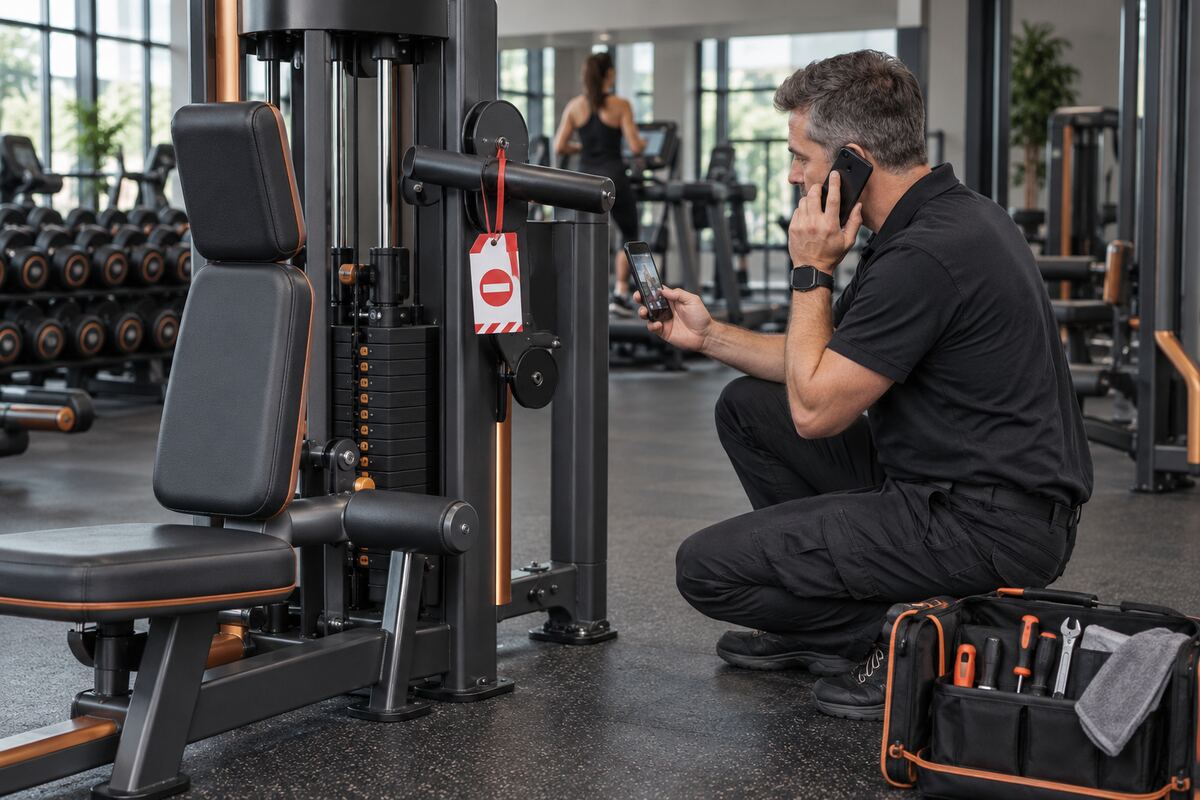
The first action is physical, and it happens before any gym equipment support call is made. Power down at the isolator where one exists, remove the safety key, and take the unit out of use in a way a distracted member cannot undo. A note taped to a console is not isolation.
Then clear the space around it. A machine out of service becomes an obstruction, a place to put bags, and occasionally a trip hazard, which is why the OSHA guidance on walking-working surfaces is worth reading before you improvise a cordon. Keep the circulation route intact even if it means moving the unit rather than the barrier.
Hour One: Triage Before You Call Anyone
Ten minutes of structured observation will change what the call sounds like. Record the asset identifier, the exact symptom, what the member was doing when it happened, any error code, whether it is reproducible, and whether anything else on the same circuit behaved oddly.
Photograph the console, the fault, and the surrounding floor. Note the time. Good gym equipment support depends almost entirely on the quality of information available at the start, and a technician working from “it stopped working” is guessing at the same rate you are.
Hour Two: Opening a Gym Equipment Support Call That Gets Answered
Call rather than email, then confirm in writing. A phone call establishes the facts and a written record establishes the clock, and you need both to hold anyone to a response time.
State four things: asset and serial number, symptom with any code, safety status, and the commercial position — whether the unit sits under warranty, under an agreement, or on a per-call basis. That last point changes who answers and how quickly, so it belongs in the opening sentence rather than the third email. Ask for a reference number before you hang up, and write it down.
Hours Two to Four: Rebuilding Capacity Around the Gap
One unit down is rarely one problem, and this is where gym equipment support stops being a supplier matter and becomes an operating one. A failure displaces demand onto neighboring machines at exactly the hour they are busiest, and that second-order congestion is what members actually complain about.
Decide quickly whether to redistribute or absorb. Redistributing means moving a lightly used unit into the gap, opening a reserved area, or shifting a class off the affected zone. Absorbing means accepting the queue and saying so. Either is defensible; drifting between them without deciding is not.
Hours Four to Eight: Parts, Lead Times and the Honest Estimate
By the middle of the first day you should know whether this is a stocked part, an ordered part, or a diagnosis that has not concluded. Those three have very different consequences for the floor and should never be reported to a manager as the same thing.
Ask the supplier for a part number, a stock position and a shipping date rather than a duration. “About a week” is not information. Where cover was purchased, check what the agreement actually promises about parts, because that clause is usually the difference between a two-day and a two-week outage, as covered in the economics of a service agreement.
The Gym Equipment Support Escalation Clock
Escalation fails because nobody agreed in advance what “too long” means. Fix the thresholds before the incident, publish them, then apply them without negotiation on the day. Every hour in the table below is a point at which gym equipment support either moved or did not.
| Elapsed | What must be true | Owner | Escalate if not |
|---|---|---|---|
| 0–15 min | Unit isolated, area cleared, signage placed | Duty manager | Immediate — this is a safety item |
| 60 min | Triage record complete with photographs | Duty manager | Escalate to the general manager |
| 2 hours | Call logged, reference number held in writing | Operations lead | Call the account manager directly |
| 4 hours | Acknowledgment received naming a technician or a date | Operations lead | Invoke the agreement’s response clause |
| 8 hours | Diagnosis or a booked visit; part identified where known | Supplier | Request written confirmation of the delay |
| 12 hours | Members informed with a stated expectation | Front desk | Escalate to whoever owns member communication |
| 24 hours | Repair date and shipping date both in writing | Operations lead | Ask for an interim unit or a loan machine |
| 48 hours | Fix completed, or a written plan with a firm date | General manager | Escalate above the account manager |
Hours Eight to Sixteen: Telling Members Something True
Silence is read as indifference and vague optimism is read as a lie. The sign on the machine should say what is wrong in plain terms, what is being done, and when you will next update — even when the honest answer is that you do not yet know.
Brief the desk with one sentence everybody uses, so a member does not get three different stories in an afternoon. Where members have been redirected to other equipment, say where, because the substitution behavior described in why members bypass working machines starts within days rather than weeks.
Hours Sixteen to Twenty-Four: Logging It So It Counts
An incident that leaves no record has cost you money twice. Write the asset identifier, the fault, the downtime in hours, the response times against the clock above, the parts used and the total cost including staff time. This log is also the only evidence of whether your gym equipment support arrangement is performing.
Downtime hours are the number most operators fail to capture and later wish they had. That figure is what makes the case in the repair-or-replace arithmetic, and it cannot be reconstructed from memory six months on.
Hour Twenty-Four: The Debrief
Fifteen minutes, three questions, one page. Did the machine give warning that somebody saw and did not record? Did every step of the clock happen on time? Did the member-facing message hold up under questioning?
The first question usually finds something. Most sudden failures were audible, visible or reported before they happened, which is why the debrief should feed straight into the wear signals that precede a failure rather than into a filing cabinet.
Before the Next Breakdown
- Write the isolation procedure. One page per equipment family covering power-down, safety key, signage and how to cordon without blocking a route.
- Build the call card. Serial numbers, account references, gym equipment support contacts and the commercial position of each asset, held where the duty manager can reach it at six in the morning.
- Agree the clock in writing. Put the escalation thresholds above in front of your supplier and confirm which ones they accept.
- Draft the member message now. Two templates, one for a same-week fix and one for a parts wait, so nobody improvises under pressure.
- Rehearse once. Walk a fictional failure through the first four hours with the weekend staff, who are the people most likely to face the real one.
Gym Equipment Support Questions Operators Ask
Should we attempt any repair ourselves?
Consumables and adjustments, yes. Anything on a load path, an electrical assembly or a component under warranty, no. An in-house attempt that fails typically costs more than the original fault, because the technician now has two problems, and it can void the cover that would have paid for the repair.
How long is too long for a first response?
Judge it against what you bought rather than a general standard. If an agreement specifies a response window, the clock above should mirror it. Where gym equipment support is bought per call, an acknowledgment inside four working hours and a diagnosis inside two working days is a reasonable expectation to state plainly when you open the call.
What if the supplier disputes the fault is theirs?
Keep the machine untouched and the record complete. Photographs, error codes and the service history usually settle it faster than argument. Where the disagreement is about whether a component should have failed at all, the technical committee behind fitness product standards is the reference frame both sides recognize.
Is it worth keeping a spare unit for this?
For high-duty assets in a single-site facility, often yes. A retired but working machine kept in storage costs floor space and nothing else, and it converts a two-week parts wait into an inconvenience. Judge it on the downtime hours in your own log rather than intuition about how often things break.
Judged on the Recovery, Not the Fault
Members forgive breakdowns. They do not forgive being kept in the dark, finding the same tape on the same console two weeks later, or watching a facility appear surprised by something entirely ordinary. Strong gym equipment support is mostly a matter of having decided everything above before the phone rang, and then doing it the same way every time.