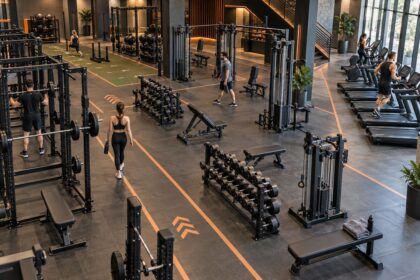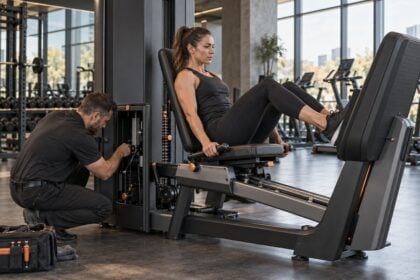

Almost every assessment of commercial gym equipment durability starts at the frame, and the frame is almost never what ends a machine’s working life. Frames outlive their owners’ interest in them. What actually retires a selectorized station or a plate-loaded press is a bushing that was chosen on price, a cable nobody could source, a pad that split at the seam, or a bolt sitting behind a shroud that made a twenty-minute job into a service visit.
- Commercial Gym Equipment Durability Is Decided Before Delivery
- Failure Mode One: Welds That Look Right and Load Wrong
- Failure Mode Two: Bushings Chosen for Cost, Bearings for Show
- Failure Mode Three: Cables and Pulleys Specified as an Afterthought
- Failure Mode Four: Upholstery and Grips at the Contact Points
- Failure Mode Five: Finish That Fails Where Hands and Plates Land
- Failure Mode Six: Fasteners You Cannot Reach
- Failure Mode Seven: The Support Chain That Bounds Commercial Gym Equipment Durability
- A Pre-Purchase Inspection Scorecard
- The Week Before Delivery
- Questions Buyers Ask About Build Quality and Service Life
- Does a longer warranty mean better commercial gym equipment durability?
- Is heavier equipment more durable?
- How long should a commercial strength machine last on a busy floor?
- Can in-house staff maintain equipment without voiding cover?
- Where the Real Assessment Happens
That gap between where buyers look and where machines fail is worth closing before the order is placed, because none of these components can be changed afterward. The seven failure modes below recur in roughly the order they appear on a floor, and each has a check you can run on a showroom unit in minutes.
Commercial Gym Equipment Durability Is Decided Before Delivery
Commercial gym equipment durability is not a property of a machine on its own. It is the product of how the machine was built and how it will be supported, and the second half is at least as decisive as the first. A well-made unit with a twelve-week parts lead time delivers less usable service life than an average one with next-day parts.
Read what follows as two audits: one with your hands on the equipment, one on the supplier’s paperwork. Skipping either produces the same outcome — a machine that is technically covered and practically unavailable.
Failure Mode One: Welds That Look Right and Load Wrong
The visible weld is a cosmetic decision; the load path is a structural one. Look at where the weld sits relative to the force it carries, whether the joint is gusseted at points of leverage, and whether beads run consistently rather than heavy at the start and thin at the end. Grinding and paint hide a great deal.
Check the underside and rear of a showroom unit, rarely finished to the standard of the display face. Ask whether frames are jigged and whether joints are welded both sides. Inconsistency is the earliest signal in commercial gym equipment durability, because it predicts manufacturing discipline everywhere downstream.

Failure Mode Two: Bushings Chosen for Cost, Bearings for Show
Pivots are where a machine keeps its feel or loses it. Sealed bearings are quieter and last longer in high-cycle positions; good bushings are adequate in low-cycle ones and cheaper to replace. The problem is not which type is used but whether the choice matches the duty at each pivot.
Ask for a pivot-by-pivot list stating the component at each location; a manufacturer who thinks about commercial gym equipment durability answers immediately. Then work every arm through its full range and listen: a pivot that ticks or binds cold will do both louder in year two.
Failure Mode Three: Cables and Pulleys Specified as an Afterthought
Cable assemblies behave like structural parts until they fail, at which point the machine is out of service until an exact replacement arrives. Capture diameter, construction, coating, breaking strength and — above all — whether the assembly is a standard sourceable length or a proprietary item with swaged ends unique to that model.
Pulleys matter as much to commercial gym equipment durability. Check groove profile, material, and whether the sheave runs on a bearing or a plain bore. Undersized pulleys accelerate cable fatigue quietly, and a machine that eats cables is expensive long before anything looks broken.
Failure Mode Four: Upholstery and Grips at the Contact Points
Pads and grips are what members touch, so they shape perceived quality regardless of what the frame is doing. They are also the cheapest parts to replace — provided they were designed to be replaced.
The check is mechanical. Is the pad bolted to a board that unbolts from the frame, or bonded to a moulded part you would replace whole? Where do the seams sit relative to where weight lands? A stitched seam directly under the sitting point splits first, every time.
Failure Mode Five: Finish That Fails Where Hands and Plates Land
Powder coat is not one thing. Coverage, pre-treatment and thickness vary enormously, and the difference shows first at weight horns, plate pegs and anywhere a bar rests on steel. Once coating breaks there, corrosion runs underneath and spreads faster than the visible damage suggests.
Ask what pre-treatment the frames get before coating, because adhesion depends on it more than on the coating. Look at contact points rather than flat panels, and check whether liners or sacrificial surfaces are offered where steel meets steel.
Failure Mode Six: Fasteners You Cannot Reach
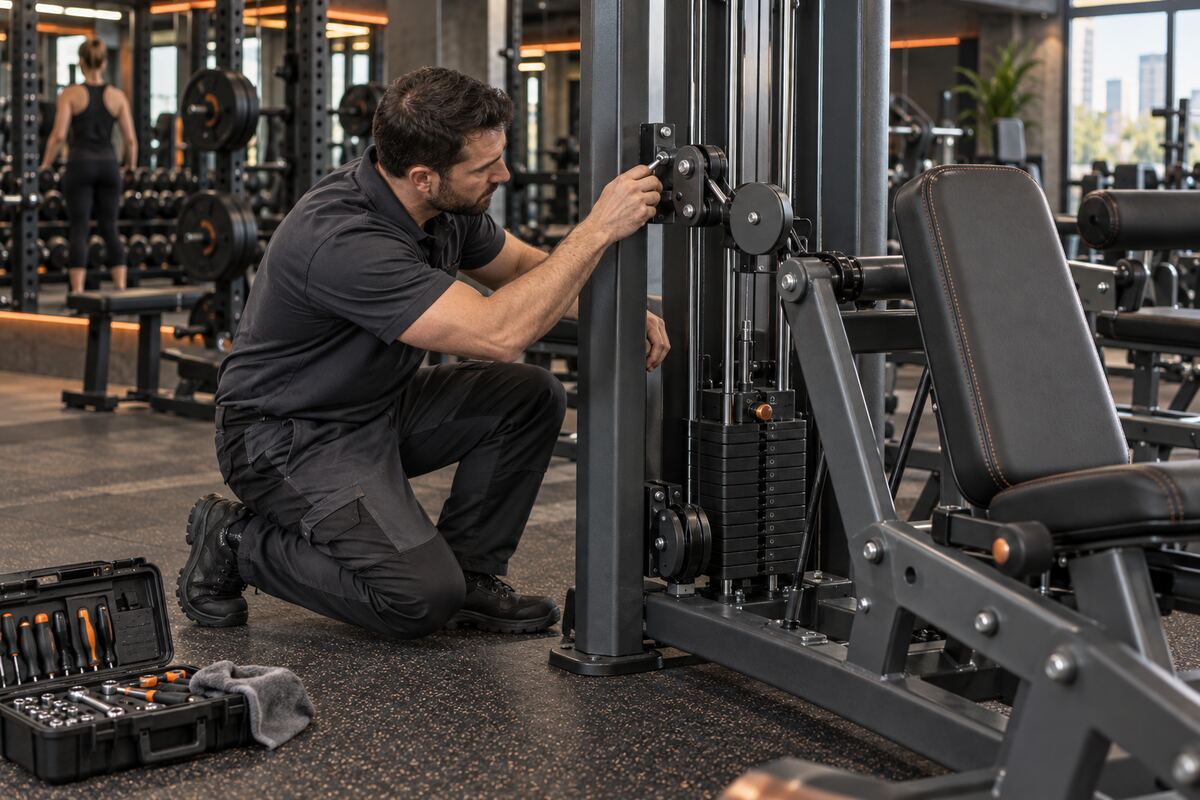
Serviceability is part of commercial gym equipment durability, not a maintenance convenience. Every fastener needing a shroud removed, a stack unloaded or a second technician is a repair that gets deferred, and deferred repairs turn small faults into replacements. Buyers notice this one last and regret it longest.
Walk a showroom machine with the question “how would I change the cable?” and then “how would I change the pad?” If the answer to either involves partial disassembly, price that time into the purchase. The specification behind the machine deserves the same scrutiny — ASTM Subcommittee F08.30 on Fitness Products is the committee that writes the consensus standards for this equipment, and asking which of them a model was tested against tells you more about commercial gym equipment durability than the frame warranty does.
Failure Mode Seven: The Support Chain That Bounds Commercial Gym Equipment Durability
The last failure mode is not on the machine. A part that takes ten weeks to arrive turns a two-hour repair into a quarter of lost revenue on that station, and no amount of frame quality compensates. In practice, durability is bounded by whoever answers the phone.
Ask three questions in writing: what is held in regional stock, what is the target dispatch time for a common wear part, and may your own staff fit routine consumables without affecting cover? The answers separate suppliers far more sharply than build specification does, which is the argument behind the difference between a seller and a genuine equipment partner and behind what has to happen in the first 24 hours of a breakdown.
Reinvestment planning belongs in the same conversation. Guidance from the Health & Fitness Association on when clubs should buy new equipment treats replacement as a planned annual line rather than an emergency — possible only if you know which parts fail and how fast they arrive.
A Pre-Purchase Inspection Scorecard
Take this commercial gym equipment durability check to a showroom or reference site and complete it on the actual unit. Twenty minutes per machine, and the cheapest due diligence available.
| Check | What to do | Pass | Fail |
|---|---|---|---|
| Weld consistency | Inspect underside and rear joints | Even beads, gussets at leverage points | Thin or uneven beads, no gusseting |
| Pivot specification | Request pivot-by-pivot component list | List provided; bearings at high-cycle points | General assurance only |
| Pivot feel | Cycle every arm cold, full range | Smooth and silent throughout | Ticking, binding or play |
| Cable assembly | Get diameter, construction and end type | Standard, sourceable, spec documented | Proprietary swage, spec unavailable |
| Pulley quality | Check groove, material and bearing | Bearing sheave, matched groove profile | Plain bore, undersized diameter |
| Pad construction | Look for seam position and mounting | Bolted board; seams off the load point | Bonded assembly; seam under load |
| Finish at contact points | Examine horns, pegs and rest points | Pre-treatment stated; liners fitted | Coating already marked on display unit |
| Fastener access | Ask how a cable and a pad are changed | Hand tools, no disassembly | Shroud removal or stack unload required |
| Parts availability | Request stock and dispatch commitments | Regional stock, stated dispatch time | Order per incident, no target |
| In-house service rights | Read the written warranty terms | Routine consumables permitted | Any intervention voids cover |
The Week Before Delivery
- Order the first set of consumables now. Cables, pads, grips and liners for the units you are taking. Holding them from day one converts your worst downtime scenario into an afternoon.
- Photograph every machine on arrival. Contact points, welds, pads and finish, before a single member uses them. That baseline settles every warranty conversation you will have for a decade.
- Confirm the service rights in writing. Get the one sentence naming which routine replacements your staff may perform, filed with the warranty rather than in an inbox.
- Build the wear-part register. One row per machine listing part numbers, lead times and who supplies them, so nobody is searching for a reference during a breakdown.
- Set the inspection interval before the floor gets busy. Assign a named role and a walk every two weeks, using the scorecard’s physical checks as the standing list.
Questions Buyers Ask About Build Quality and Service Life
Does a longer warranty mean better commercial gym equipment durability?
Not by itself. Warranty length reflects commercial positioning as much as engineering confidence, and the exclusions carry more information than the headline term. Read what is excluded, what counts as wear, and how a claim is made. A shorter warranty with fast parts often delivers more uptime.
Is heavier equipment more durable?
Mass helps rigidity but says nothing about pivots, cables, pads or finish, which are what actually fail. A heavy machine with plain-bore pulleys and bonded pads will be out of service sooner than a lighter one specified properly. Weigh the frame if you like, then inspect the components that move.
How long should a commercial strength machine last on a busy floor?
Commercial gym equipment durability varies far too widely with traffic, environment and maintenance for any single figure to be honest. The useful framing is cost per year of availability, tracked per machine, including downtime. Once you have two or three years of that data, replacement decisions stop being arguments and become arithmetic.
Can in-house staff maintain equipment without voiding cover?
Often yes for routine consumables, and often no for anything involving structure or electronics. The answer is specific to the contract, so get it in writing before purchase rather than discovering it during a claim. Suppliers who permit sensible in-house work usually have better parts logistics behind them too.
Where the Real Assessment Happens
A showroom rewards frames and hides everything that decides service life. Twenty minutes with your hands on the pivots, your eyes on the seams and three written questions about parts tells you more about commercial gym equipment durability than any brochure. Do it before the order, keep the delivery-day photographs, and treat the wear signals that precede a failure as a schedule. When the numbers turn, a service agreement can be worth more than it costs — but only where the parts exist.