
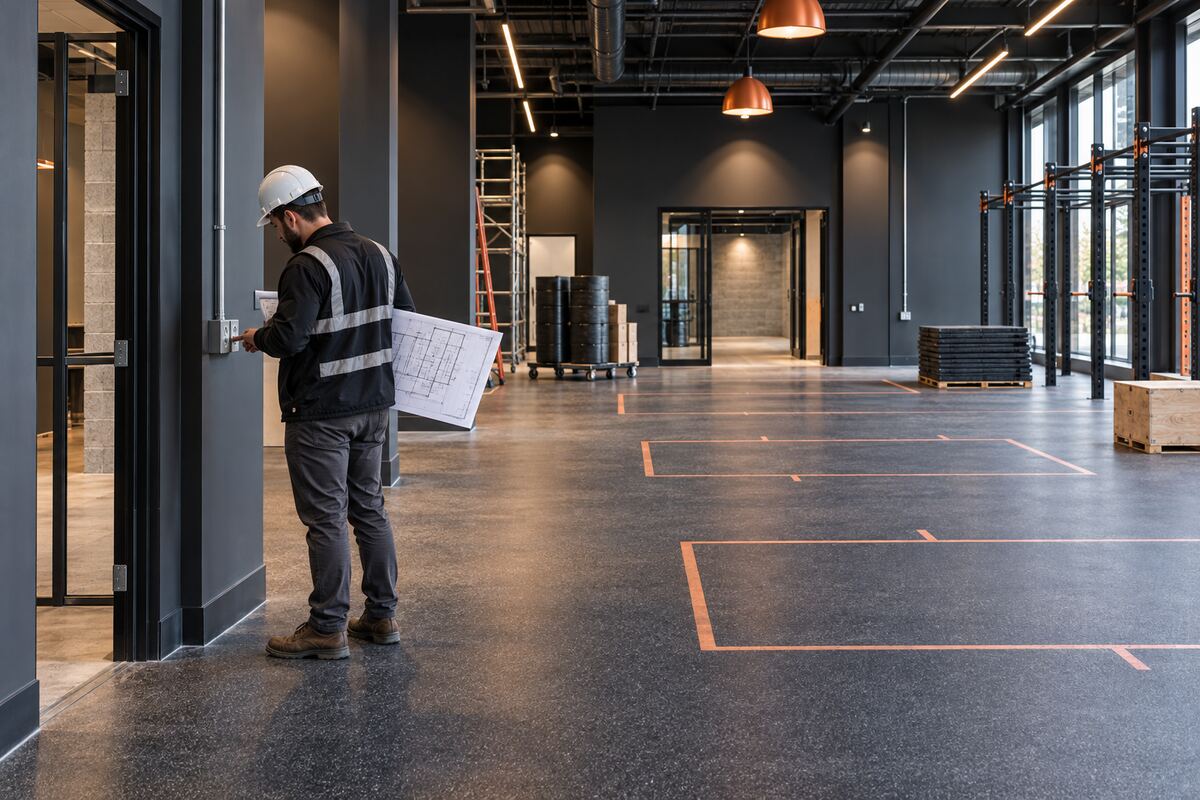

Gym equipment installation is the one line on a fit-out program that cannot be recovered by working harder on the day. The crew arrives with a fixed number of hours, a fixed route into the building, and a trailer that has to be emptied whether or not the floor underneath it has cured.
- The gym equipment installation countdown runs backward from the truck
- Day 30 to Day 24: prove the route, not the room
- Day 23 to Day 18: freeze the information
- Day 17 to Day 12: sequence the trades against the cure date
- Day 11 to Day 7: test the utilities rather than assume them
- Day 6 to Day 3: rehearse the floor at full scale
- The gym equipment installation readiness table
- Day 2 and Day 1: hold the go or no-go gate
- The four weeks before the truck arrives
- Questions operators ask before the truck is booked
- How far ahead should a gym equipment installation be booked?
- What actually happens if the floor is not cured on the day?
- Can we take a partial delivery if only half the site is ready?
- Who should attend the go or no-go review?
- The moment the truck is confirmed
Everything that decides how that day goes is settled in the thirty days before it. Treat the month as a countdown rather than a checklist. Each window closes on a date, and the final window closes on a single decision: confirm the truck, or move it.
The gym equipment installation countdown runs backward from the truck
Programs built forward from the contract date drift quietly, because nothing in them becomes urgent until it is late. A countdown built backward from the delivery slot behaves differently: every dependency declares the date it must be finished by, which makes a slipping trade visible while there is still room to move it.
Give each line four fields: owner, due date, evidence, status. Evidence is the field that does the work. “In progress” is not evidence. A dated photograph of a protected floor, a moisture reading, a written lift booking or a measured door opening is.
Day 30 to Day 24: prove the route, not the room
Walk the path a crated leg press will actually travel, from the point where a truck can legally stop to the tile the machine will stand on. Measure dock height, curb drop, door leaf width with the door removed, the tightest turn, lift car depth, and ceiling clearance at the lowest duct.
Compare them against crated dimensions and weights on the order, not the finished machine dimensions in the brochure. Confirm work hours, parking, escort rules, lift reservations and the certificates the installer’s insurer requires before anyone is allowed to mobilize. A gym equipment installation crew that cannot get its vehicle onto the site loses its first two hours to a parking lot.
Where the route crosses live construction, the surface underfoot is a genuine hazard to a two-person carry. OSHA’s material on walking-working surfaces covers the housekeeping, level-change and clearance conditions worth resolving before crates start moving through the building.
Day 23 to Day 18: freeze the information
Reconcile the purchase order, the equipment schedule, upholstery and frame finishes, quantities, accessories, the placement plan, power and data positions, anchor details and any ceiling attachments. Every substitution and long-lead exception is named here, in writing, alongside the person who accepted it. Most gym equipment installation disputes trace back to two parties reading different versions of the same schedule.
After this date the information is frozen. A change is still possible, but it now has to be priced against route, utilities, placement, crew hours and opening date before anyone approves it. How that pricing gets done is a governance question, and the approval thresholds behind an equipment order decide whether a late change is absorbed or argued about.

Day 17 to Day 12: sequence the trades against the cure date
Flooring is usually the constraint nobody puts on the critical path. Rubber, vinyl and poured surfaces all have a cure or settling period, and heavy point loads rolled across an uncured floor leave marks that cannot be buffed out afterward. Ask for the cure date in writing and put it on the countdown beside the delivery date. Cure time is the most common reason a gym equipment installation moves inside its final two weeks.
Then decide which trades can overlap and which need exclusive access. Electrical energization, network cabling, mirrors, ceiling work and final paint all compete for the same rooms. Protect the installation zones from becoming the storage area for everyone else’s materials.
Day 11 to Day 7: test the utilities rather than assume them
Energized is not the same as tested. Put a load on the circuits that will feed treadmills, confirm that dedicated circuits are genuinely dedicated, and check receptacle positions against the placement plan rather than the drawing. A socket 400mm from where a console needs it becomes a change order on delivery day.
Do the same for data. Confirm wireless coverage at the far corner of the strength floor rather than beside the router, and confirm that somebody can actually onboard equipment to the network on the day the crew wants to commission it. A console that cannot join a network turns a finished gym equipment installation into an unfinished one.
Day 6 to Day 3: rehearse the floor at full scale
Tape out the major footprints and walk them. Check working envelopes, the space a loaded bar needs behind a rack, cleaning routes, storage and staff sightlines. Reviewing the layout signals that reveal hidden congestion at tape stage costs nothing; moving an anchored rack afterward costs a day of crew time.
Daily operating routines belong in this rehearsal too, not in a later correction. Walk the cleaning circuit, the towel run and the between-class reset exactly as they will happen once the room is live; the Health & Fitness Association’s best practices for operating a fitness facility are a reasonable checklist of what those routines have to accommodate. Settle them with your design professional while the floor is still tape.
The gym equipment installation readiness table
This is the sheet the go or no-go review works from. One amber rarely stops a truck; two ambers on the same route usually should.
| Checkpoint | Proof due by | Green | Amber | Red: do not confirm |
|---|---|---|---|---|
| Delivery route | Day 24 | All clearances measured against crated dimensions | One pinch point within tolerance | A crate that does not fit and no alternative route |
| Floor finish | Day 12 | Cured, protected, moisture reading recorded | Cured but protection not yet ordered | Cure date falls after the delivery date |
| Power | Day 7 | Load-tested at final outlet positions | Energized, outlet positions unverified | Temporary site supply only |
| Network | Day 7 | Tested at the far corner, credentials issued | Coverage tested, nobody available to onboard | No network live on site |
| Equipment schedule | Day 18 | Frozen and signed, substitutions listed in writing | Frozen with one open exception | Quantities still under discussion |
| Anchors and structure | Day 12 | Fixings confirmed in writing by the designer | Confirmed verbally only | Unknown slab depth under a rack line |
| Access permissions | Day 24 | Hours, parking and lift booked in writing | Booked verbally | Building manager not yet contacted |
| Receiving people | Day 3 | Named site lead plus cover | Named lead with no cover | Nobody authorized to reject a damaged item |
| Waste and packaging | Day 10 | Container on site for the delivery date | Container booked for the following day | No removal plan at all |
| Go or no-go owner | Day 2 | One named person who can move the truck | Two people share the decision | Decision escalates off site |
Day 2 and Day 1: hold the go or no-go gate
The gate is a short meeting with the readiness table on screen and no verbal reassurance accepted in place of evidence. Route open, floor accepted, utilities tested, zones clear, exceptions owned. A gym equipment installation is not delayed by a no-go call; it is delayed by discovering the same facts on the morning of delivery.
If the site is not ready the choice is not simply delay or proceed. Compare a moved slot, a partial delivery of what can be placed, off-site storage with a second delivery charge, or resequencing the crew. A supplier with real local control over the delivery schedule can usually offer more of those options than one working from a distant hub.
The four weeks before the truck arrives
- Book the route walk this week. Bring a tape, the crated dimensions and whoever controls building access. Photograph every pinch point and record the measurement in the same frame.
- Publish one gym equipment installation tracker. Owner, due date, evidence, status. One shared location, one version, no rival spreadsheet in anybody’s inbox.
- Set the information freeze date and tell the supplier. Put it in writing at Day 23 and state what a post-freeze change will be assessed against before it is approved.
- Put the flooring cure date on the critical path. Get it in writing from the flooring contractor and compare it to the delivery date immediately, not at the gate.
- Name the go or no-go decision-maker. One person, named in writing, with the authority to move a booked truck without escalating.
Questions operators ask before the truck is booked
How far ahead should a gym equipment installation be booked?
Far enough that moving it is still cheap. Booking early protects the crew and the vehicle; the readiness work then decides whether you keep the slot. What you should avoid is booking so late that the only available date sits inside your flooring cure window.
What actually happens if the floor is not cured on the day?
Either the crew rolls heavy point loads across an uncured surface and you accept permanent marking, or the equipment gets staged elsewhere and moved again later. The second option costs a return visit. Neither is free, which is why the cure date belongs on the countdown.
Can we take a partial delivery if only half the site is ready?
Often yes, and it is usually cheaper than a full postponement. Agree in advance which zones are in scope, where the remainder will be stored, who pays for the second delivery, and how the split affects your commissioning and acceptance sequence.
Who should attend the go or no-go review?
The named decision-maker, the site lead, the main contractor’s representative and the distributor’s project contact. Four people with authority beat twelve people with opinions. Anyone who cannot make a commitment on the call does not need to be on it.
The moment the truck is confirmed
A month of countdown ends at one sentence: the site is ready, send it. Everything before that is about surfacing constraints while they can still be solved cheaply. Once the slot is confirmed the countdown is finished, and gym equipment installation hands over to a different discipline entirely: the receiving and acceptance work that begins when the trailer doors open. Hand over cleanly, and the crew inherits a building instead of a problem.