
For two decades, health club fee caps in California have been a contract-law footnote that rarely reached an equipment meeting. A bill now sitting on the governor’s desk moves them into one.
- The enrolled text amends one section of the Civil Code
- Health club fee caps were a contract rule, not a pricing rule
- The thirteen-item list reads like a capital plan
- Which qualifying amenities land on an equipment order
- What suppliers into California should expect to be asked
- Distributors will feel it as a lead-time question
- Recovery and studio rooms are the contested square footage
- Health club fee caps in other states have not moved either
- Five things to do before the signing deadline passes
- Questions operators are asking about health club fee caps
- Does this let California clubs charge more per month
- Is the bill law right now
- Do independent studios escape health club fee caps
- Should suppliers change quoting terms because of health club fee caps
- The definition is now the product decision
According to the official bill history published by LegiScan, AB 2402 was “Enrolled and presented to the Governor at 4:30 p.m.” on August 24, 2026. The Health & Fitness Association announced its backing the following day. The bill does not raise the ceiling. It creates a class of facility that health club fee caps no longer apply to, and membership in that class is decided by what a building physically contains.
The enrolled text amends one section of the Civil Code
AB 2402 amends Section 1812.86 of the California Civil Code, the provision that sets health club fee caps on what a health studio may collect under a contract. The bill text records the history plainly: a $3,000 limit inclusive of initiation or initial membership fees took effect January 1, 2006, and the $4,400 limit that operators work under today took effect January 1, 2010.
Neither figure moves. What the bill adds is an exemption for a “multiservice health club studio,” a term defined by an amenity test rather than by revenue, floor area or member count. A facility offering three or more items from a thirteen-item list falls outside health club fee caps.
Health club fee caps were a contract rule, not a pricing rule
This distinction gets lost in trade coverage and it matters to anyone quoting equipment into California. Health club fee caps never limited what a club could charge per month. They limited what could be committed under a single prepaid contract, initiation fees included.
The practical effect was on structure. Long prepaid terms, founder memberships and bundled multi-year deals were the instruments that got squeezed, and those are precisely the instruments operators use to fund a capital purchase ahead of a build.
The thirteen-item list reads like a capital plan
The qualifying amenities, as recorded in the enrolled bill text, are digital platform services, individualized training programming, fitness instructor training or certification, recurring group fitness classes, coworking space, childcare, swimming pools, steam room, laundry services, onsite food and beverage, spa treatments, adult or youth sports programming, and locker rooms.
Roughly half of those items are build items with lead times, contractor coordination and a line on an equipment order. A pricing statute has quietly become a specification question.
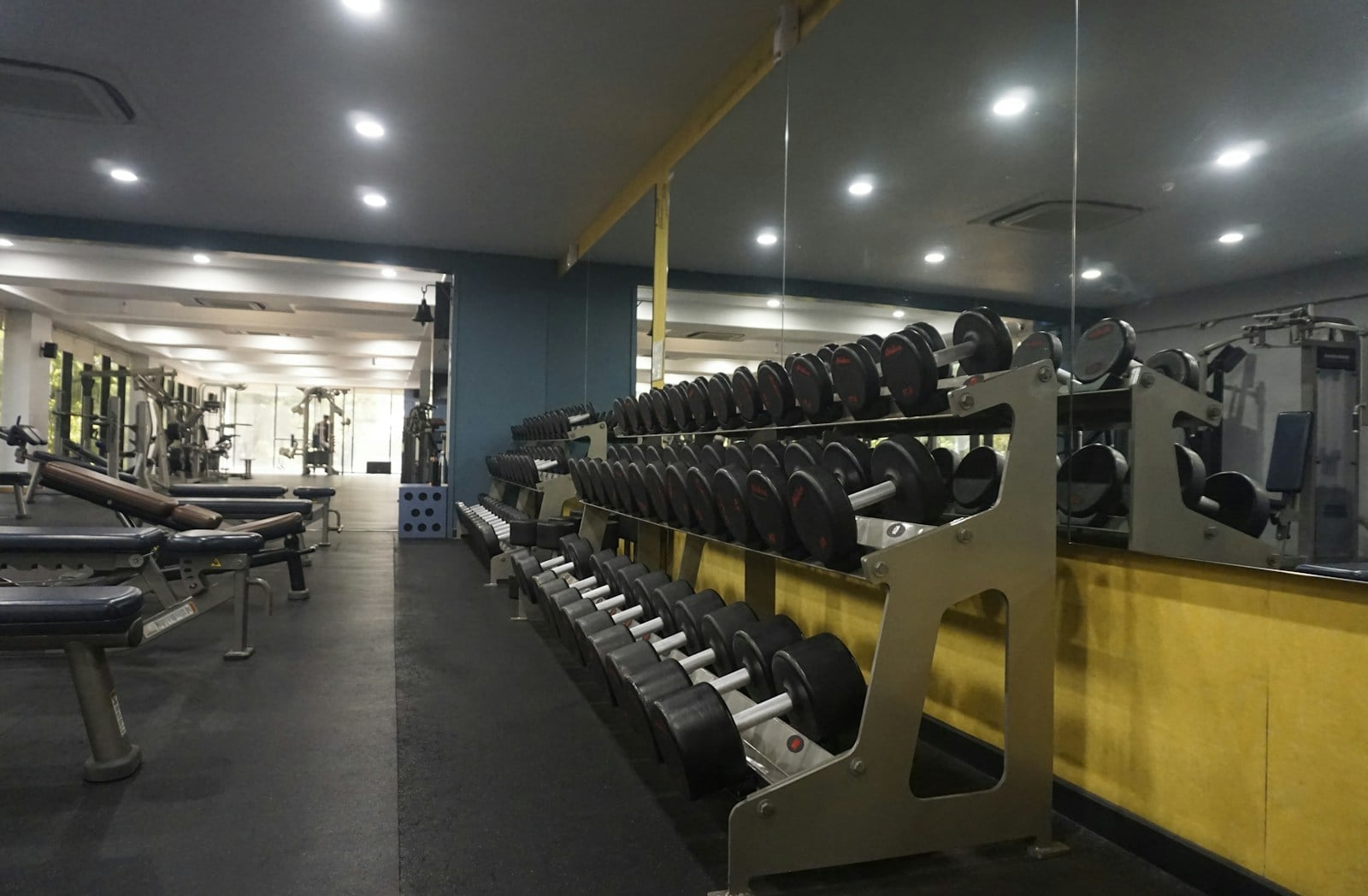
Which qualifying amenities land on an equipment order
The table below maps eight of the thirteen listed amenities to the practical question a distributor or supplier will be asked in the next two quarters. The amenity names are taken verbatim from the enrolled bill text; the trade implications are editorial.
| Qualifying amenity (bill text) | Capital weight | Question the supplier gets first | Floor-space consequence |
|---|---|---|---|
| Recurring group fitness classes | Moderate | Storage and reset carts for a shared studio | Converts open floor, not machine floor |
| Individualized training programming | Low to moderate | Small-group rigs and assessment stations | Takes strength-floor perimeter |
| Locker rooms | High | Nothing — it goes to the contractor | Removes floor permanently |
| Childcare | High | Nothing — licensing and egress lead | Removes floor permanently |
| Swimming pools | Very high | Deck equipment and deck-rated finishes | Usually a shell expansion |
| Steam room | Moderate | Adjacency to recovery equipment already installed | Competes with recovery zone |
| Coworking space | Low | Power, not equipment | Takes the least productive corner |
| Onsite food and beverage | Low to moderate | Nothing — it goes to a separate vendor | Takes lobby, rarely training floor |
The cheapest routes to qualifying are programming and service items; the expensive routes are construction. An operator who needs three qualifying amenities will reach for the cheap ones, and two of the three cheap ones are equipment-adjacent rather than equipment-heavy.
What suppliers into California should expect to be asked
Expect the question to arrive framed as compliance rather than procurement. Operators will want to know whether a proposed small-group rig, a class studio fit-out or a recovery room can be documented as one of the listed amenities.
Suppliers cannot answer that question. What a supplier can do is provide a clean scope description, a dated delivery schedule and a room-by-room equipment schedule the operator’s counsel can attach to their own analysis. That is a document request, not a legal opinion, and it is the discipline that keeps the spec from going unowned between design and purchase.
Distributors will feel it as a lead-time question
If the bill is signed, the operators most motivated to act are those with a contract structure already straining against the ceiling. Their instinct will be to add a qualifying amenity fast and restructure their agreements in the same quarter.
A rushed class-studio fit-out ordered against a legal deadline is the same order profile that produces the punch-list problems covered in our reporting on what happens after the delivery is signed for. Quote the real lead time.
Recovery and studio rooms are the contested square footage
Two of the listed amenities — steam room and spa treatments — sit directly on top of the space most facilities have been allocating to recovery over the last three years. That space was already competing for capital without a formal hurdle rate, a problem examined in our analysis of recovery zones winning floor space without a hurdle rate.
Now the same square footage carries a contract-law benefit. That is a new and asymmetric argument in the room, and it will beat a throughput argument unless the throughput argument is written down.
Health club fee caps in other states have not moved either
California is not alone in operating under a figure set a long time ago. The Health & Fitness Association noted in its August 25 announcement that New York’s comparable annual cap stands at $3,600 and has not been updated since 1991.
Greta Wagner, interim president and CEO of the association, said in that release that “California’s fitness industry has changed dramatically since these limits were last updated more than two decades ago.” Whether other states follow the amenity-test approach rather than a straight number increase is the thing to watch. An amenity test is a far more interesting outcome for equipment suppliers than an indexed dollar figure.
Five things to do before the signing deadline passes
- Pull your California pipeline by contract structure. Identify which pending deals depend on a prepaid or multi-year membership instrument, because those are the ones whose funding assumption changes if the bill is signed.
- Prepare a room-by-room equipment schedule template. Operators will ask for documentation that describes what a space contains and when it opens. Have the format ready rather than building it per deal.
- Separate legal questions from scope questions in writing. Answer scope, decline the rest, and put the decline in the same email so nobody later remembers a verbal assurance.
- Re-quote lead times for class studio and small-group fit-outs. These are the cheap qualifying routes and demand for them will move first.
- Flag any deal where a recovery room is being reframed as a steam room. The specification, drainage and warranty terms are not the same, and a late change here is a change order.
Questions operators are asking about health club fee caps
Does this let California clubs charge more per month
No. The cap governs what a health studio contract may commit, inclusive of initiation or initial membership fees, not the monthly rate. A qualifying multiservice facility gains freedom in how it structures prepaid and long-term agreements. Monthly pricing was never the constrained variable, which is why the change is a balance-sheet story rather than a rate-card story.
Is the bill law right now
Not as of this writing. LegiScan’s history shows the bill enrolled and presented to the governor on August 24, 2026, which is the step before signature or veto. Until it is signed, the existing $4,400 limit recorded in Civil Code Section 1812.86 continues to apply to every California health studio contract without exception.
Do independent studios escape health club fee caps
Only if they offer three or more of the listed amenities. A single-discipline studio running one program in one room does not meet the test on program quality; it meets it on breadth. Several small operators will find that adding a certification program and a digital platform is cheaper than adding a room, which is a real strategic choice rather than a paperwork one.
Should suppliers change quoting terms because of health club fee caps
Not the terms, but the documentation. Deposit structures may loosen for qualifying facilities and tighten for those still under health club fee caps, so the useful change is knowing which side of the definition a customer sits on before the deposit conversation, rather than discovering it at contract stage.
The definition is now the product decision
For twenty years the trade treated health club fee caps as somebody else’s regulation. AB 2402 attaches a thirteen-item amenity list to a financial outcome, and that list is written in the language of rooms and services rather than dollars. Suppliers who can describe a scope precisely and schedule it honestly will be more useful to California operators this fall than suppliers who can only quote a price, as the framework in our piece on deciding which floor-space requests deserve capital already suggested.
Sources: Health & Fitness Association announcement, August 25, 2026 and the enrolled text and history of California AB 2402.