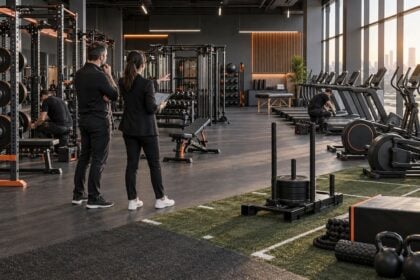
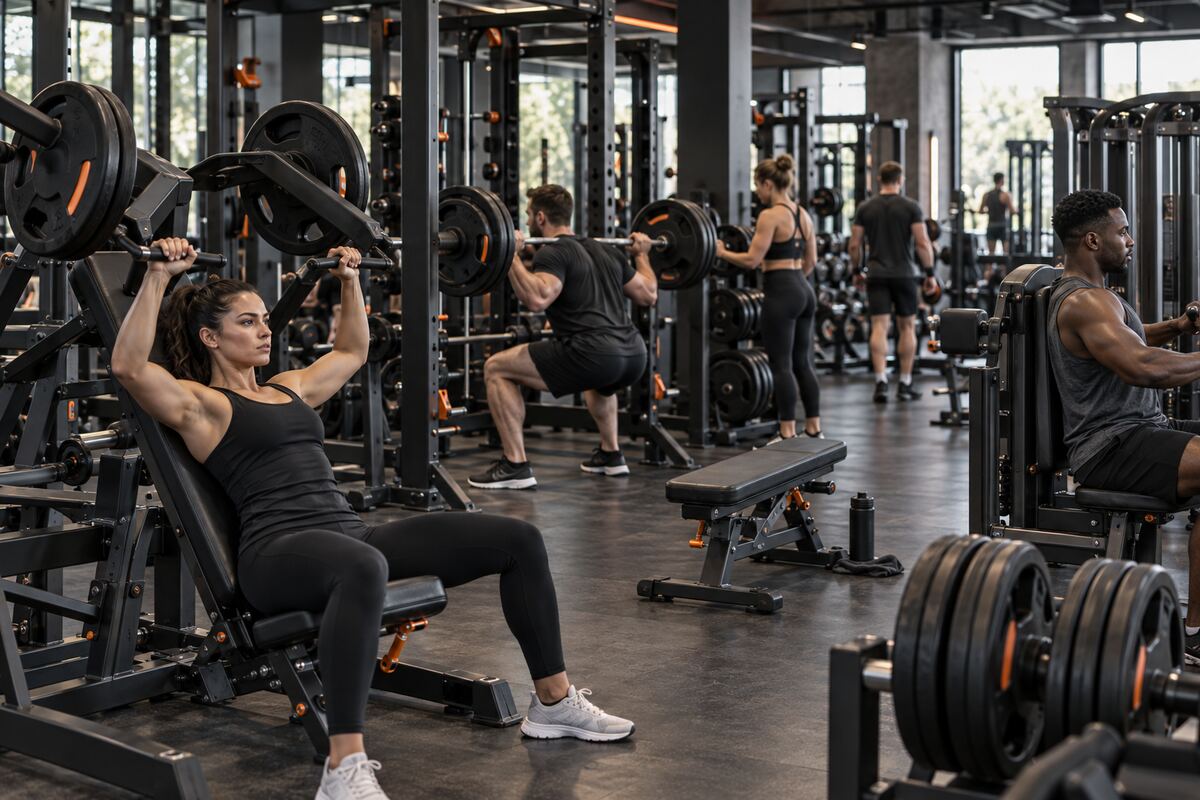

Ask an operator which pieces members cross the room for, and the answer rarely matches the order the catalog lists them in. Strength equipment trends have tilted toward plate-loaded stations, and the reason has less to do with engineering than with what the machine communicates from twenty feet away. A member can see the load. A member can see somebody else add to it.
- Two Floors, One Framework
- Floor One: A Circuit Room With Three Loaded Pieces at the Back
- Floor Two: Loaded Stations on the Main Sightline
- Visible Progression Is the Engine Under Strength Equipment Trends
- Movement Choice Beats Station Count
- The Social Layer Nobody Puts on a Spec Sheet
- What Strength Equipment Trends Change About Quantity and Placement
- Where the Plates Live Between Sets
- Reading the Two Floors Side by Side
- Five Checks Before the Order Hardens
- Questions Operators Ask About Loaded Floors
- How many plate-loaded stations does a mid-size independent actually need?
- Does plate-loaded equipment need more floor space than selectorized?
- Will heavier plate use accelerate wear on the rest of the floor?
- How should this change the replacement plan?
- What the Floor Is Telling You
That visibility does something a weight stack cannot. It converts private effort into a public event, and gives a floor landmarks people organize a session around. The buying question that follows is not which brand, but how many, where they sit, and what happens to the plates between sets.
Two Floors, One Framework
The clearest way to read current strength equipment trends is to run two composite floors through the same six questions. Both are single-site independents of similar size, both bought within the last three years, both serve a general membership. They differ in one decision: where the plate-loaded equipment went, and how much floor it was allowed to claim.
Floor One: A Circuit Room With Three Loaded Pieces at the Back
Floor One bought a full selectorized circuit first and treated plate-loaded as an addition. Three pieces went along the back wall, past the cable stations, in the space left over once everything else had a home. The plate trees came with the machines and stayed where the installers set them down.
Usage settled within a month. The pieces were busy at peak and empty at every other hour, and the members using them arrived already knowing what they were for. Nobody discovered them, because the back wall had no sightline from the entrance, the cardio bank, or the free-weight area.
Floor One reads strength equipment trends as a product category to stock. That is defensible, and it is also why three good machines behave like an appendix rather than a destination.
Floor Two: Loaded Stations on the Main Sightline
Floor Two read the same strength equipment trends and sequenced the spend differently. Plate-loaded went in first, in a block visible from the entrance and the cardio deck, with selectorized units filling in behind. Loading lanes were drawn before the machines arrived, and plate storage was specified as its own line rather than accepted as an accessory.
The pattern that emerged was broader use across more hours and steadier progression among newer members. Staff reported fewer requests for a program and more requests for a spot, which is a different and healthier conversation.

Visible Progression Is the Engine Under Strength Equipment Trends
A selectorized stack hides progress inside a pin. A loaded station puts it on a bar the member, the person waiting and the coach can all read at a glance. That is not an aesthetic difference; it is the mechanism that makes the equipment sticky.
Progress that can be seen can be compared, and comparison drives return visits. Most of what gets described as momentum behind strength equipment trends is really this feedback loop, running with no software attached to it.
Movement Choice Beats Station Count
Operators buy breadth when depth would serve better. Eight distinct loaded movements with one unit each feels thinner at peak than five movements with two units each, because members substitute within a movement far more readily than across one.
The test is whether a member who finds a station occupied has an obvious second option for the same pattern. If not, that station generates a queue no matter how many pieces sit idle nearby. Depth in the movements members repeat is the part of strength equipment trends that actually shows up in occupancy.
The Social Layer Nobody Puts on a Spec Sheet
Loaded equipment creates brief, low-stakes interactions. Someone asks for a plate, someone offers a spot, someone strips a bar for the next person. Those exchanges are a retention mechanism, and they only happen when the layout lets people stand near each other without being in the way.
Too tight and the interactions become obstructions. Too spread out and nobody forms the loose cluster that makes an area feel occupied. The spacing question belongs with the layout clues that reveal hidden congestion before you buy, because loaded areas fail on circulation long before they fail on capacity.
What Strength Equipment Trends Change About Quantity and Placement
Two shifts matter for the order. First the ratio: a floor treating loaded stations as a destination generally needs fewer selectorized units than the original plan assumed, which is the argument running through any honest look at the balance between free weights and machines. Second the position, because this equipment underperforms badly when it cannot be seen.
Placement is the cheaper variable to get right and the more expensive to fix later. Bolted stations, loading lanes and plate storage are not things you slide six feet left on a Tuesday. Treat the sightline as a specification rather than a preference.
Where the Plates Live Between Sets
Plate storage is the part of strength equipment trends most quotes underweight and most floors regret. Every station needs storage within arm’s reach of the loading position, or plates end up on the floor, against the wall and under the next machine. That housekeeping problem becomes a trip hazard, and general guidance on keeping walking and working surfaces clear is the right frame for it.
The rule worth adopting is that storage capacity should exceed the load a station can hold, not match it. Members do not return plates to a full tree. They set them down, and the floor absorbs the difference until close.
Reading the Two Floors Side by Side
The table runs both composites through the same questions. It works as a pre-order check on any strength purchase, not only one shaped by current strength equipment trends.
| Question | Floor One (circuit-led) | Floor Two (loaded-led) | What the difference signals |
|---|---|---|---|
| Visible from entrance? | No | Yes | Discovery by new members, not just intent by existing ones |
| Depth per movement | One unit each | Two on repeated patterns | Whether a busy station makes a queue or a substitution |
| Plate storage specified | Accessory, as supplied | Separate line on the order | How much loose weight the floor carries at close |
| Loading lane width | Whatever remained | Drawn before delivery | Whether two people can work adjacent stations |
| Clear floor space checked | No | Against published guidance | Accessible use, and whether a transfer is possible |
| Off-peak occupancy | Near zero | Steady | Whether the area earns its square footage all day |
| Conversations staff field | Program requests | Spot and technique requests | Depth of engagement with the floor |
Five Checks Before the Order Hardens
Run this before the next strength order is signed, using the floor you already have as evidence.
- Map the sightlines. Stand at the entrance, the cardio bank and the free-weight area, and note which loaded stations are visible from each. Anything invisible from all three is a candidate to move.
- Count depth, not breadth. List the movement patterns members repeat weekly and record how many stations serve each. Any pattern with one station is a queue waiting for a busy Tuesday.
- Audit the plates at closing. Run a count of loose plates at the end of each shift for a week, with a phone photo as the record. That number is your storage shortfall, stated honestly.
- Check clear floor space. Confirm one unit of each equipment type has approach space positioned for transfer or seated use, and record the measurement rather than the impression.
- Reprice against the ratio. If loaded stations carry the floor, the selectorized count in the draft order is too high. Adjust before the quote hardens, with the discipline set out in the common strength floor planning mistakes.
Questions Operators Ask About Loaded Floors
How many plate-loaded stations does a mid-size independent actually need?
Fewer than most orders assume, provided the ones bought have depth on repeated movements and sit where people can see them. Depth on four or five patterns outperforms single units across nine. Count queues by movement pattern for two weeks and let that set the order, rather than a catalog page or a summary of strength equipment trends.
Does plate-loaded equipment need more floor space than selectorized?
Yes, and the extra is mostly loading lane and plate storage rather than machine footprint. Budget space on the loading side of every station and treat storage as its own specification. Floors that skip this give the space up anyway, in the form of plates left where they land.
Will heavier plate use accelerate wear on the rest of the floor?
Flooring and adjacent equipment take the load, not the station. Dropped and dragged plates damage surfaces, which is the argument for storage within reach and for the surface choices covered in what makes a free-weight floor survive years of use. The stations are usually the most durable thing in the room.
How should this change the replacement plan?
Loaded stations age slowly and predictably, so they sit at the back of a reinvestment queue while consoles and belts sit at the front. Association guidance on when clubs should buy new equipment is a reasonable frame for staging that spend across a planned annual cycle.
What the Floor Is Telling You
The pull behind strength equipment trends is not fashion, and no specification sheet captures it. It comes from load you can see, movements you can choose and people you can stand near. Buy for those three and the quantity question answers itself. Buy the category without them, and three good machines will sit against a back wall being technically excellent and functionally invisible.