
Fitness equipment innovation tests separate a machine that photographs well from one that still earns its footprint in month nine. Every launch season brings a few genuinely new ideas and a much larger pile of familiar hardware in a new shell. Both look identical on a spec sheet and in a demo run by someone who has used the product a thousand times.
- Failure Mode 1: The Demo Floor Is Not Your Floor
- Failure Mode 2: One Repetition Looks Nothing Like Four Hundred
- Failure Mode 3: The Workflow Around the Machine
- Failure Mode 4: Adoption Stalls After the Novelty Week
- Failure Mode 5: Serviceability Nobody Checked Until It Broke
- Failure Mode 6: Durability Under Careless Conditions
- Failure Mode 7: The Pilot That Had No Exit
- A Scorecard for Fitness Equipment Innovation Tests
- Decision Gates That Actually Bite
- Set the Thresholds Before Delivery
- Fitness Equipment Innovation Tests: Operator Questions
- How long should a pilot run before we decide?
- What if the manufacturer will not supply a pilot unit?
- Who on staff should own the pilot?
- Can we test an innovation without disrupting members?
- What the Floor Decides
What tells them apart is contact with a real floor: repeat use, crowded hours, staff who never saw the launch, and a technician opening the thing at six in the morning. Good fitness equipment innovation tests are built around that contact. Whether the company behind it can support it, and what the paperwork says, are separate questions handled below.
Failure Mode 1: The Demo Floor Is Not Your Floor
The first thing most fitness equipment innovation tests get wrong is the setting. A demo happens on level flooring, clear space on every side, one user at a time. Your floor has a seam under one corner, a column near the walkthrough, and an evening crowd that treats clearance as optional.
Test the innovation where it will live, not where it sells. Tape the footprint before the unit arrives and walk the approach a member will really use. If it needs eighteen inches of clearance it will never get, that is a product failure on your site however well it performs elsewhere.
Failure Mode 2: One Repetition Looks Nothing Like Four Hundred
A single rep tells you almost nothing about a new mechanism. Bearings, belts, resistance units and adjustment pins all behave differently after a few hundred cycles under uneven load. The demo unit has been maintained by the manufacturer. Yours will be maintained by whoever is on shift.
Make cycle count, not calendar time, your first gate. Decide before the pilot starts how many uses constitute a real test for that category, then log against it. If an adjustment that felt crisp on day one has play by cycle three hundred, the pilot has paid for itself.
Failure Mode 3: The Workflow Around the Machine
Useful fitness equipment innovation tests measure the workflow, not only the hardware. A machine that needs staff to reset it, unlock a screen or talk someone through a sequence has added labor to every hour it sits on the floor. That cost compounds, and it never appears on the quote.
Time three things: the handover between consecutive users, the reset a staff member performs, and the explanation a first-time user needs. Compare each against the incumbent. An innovation that adds forty seconds per handover on a busy station is a different purchase from the one the brochure describes.

Failure Mode 4: Adoption Stalls After the Novelty Week
Almost anything new gets used in week one. The interesting number is week five. Members try an unfamiliar format because it is unfamiliar, which makes a first-week spike the most misleading data any pilot produces.
Track usage weekly and read the shape of the curve, not its height. A curve that drops and then holds at a plateau found its audience. A curve that keeps dropping borrowed attention it could not keep. The plateau, not the peak, is what you are buying.
A pilot has a paperwork component too. Pin down the date the written warranty starts and whether it runs from delivery or from commissioning, and read anything sold alongside it against the FTC’s explanation of written and implied warranties, which is blunt that a service contract is a separate purchase rather than warranty cover. A trial that outlasts its own cover is a trial you finish paying for.
Failure Mode 5: Serviceability Nobody Checked Until It Broke
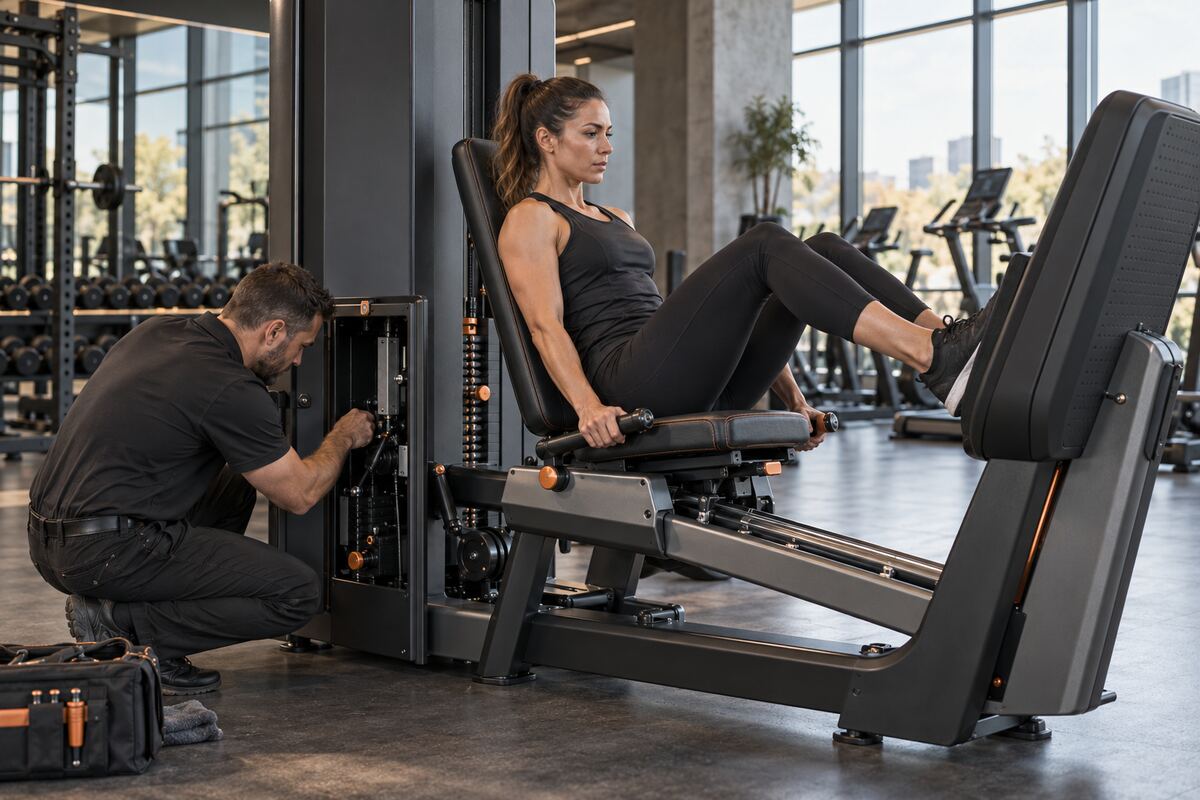
Serviceability is a property of the product, so fitness equipment innovation tests should measure it directly. Ask the technician who will actually work on the unit to open it once, in your building, with the tools they carry. Time it.
Note whether panels come off without pulling the machine out of position, whether wear parts are reachable, and whether the documentation matches the unit. A mechanism with no field-replaceable parts leaves the floor for every fault. The clearance a technician needs to work safely, covered by OSHA guidance on walking-working surfaces, belongs in the floor plan, not in the middle of a breakdown.
Failure Mode 6: Durability Under Careless Conditions
Careful use is not the test. Equipment on a commercial floor gets dropped into, leaned on, adjusted under load and cleaned with whatever is in the bottle. Honest fitness equipment innovation tests include deliberate misuse inside safe limits: the wrong pin position, the abrupt stop, the user who never reads the placard.
Inspect finish, fasteners and contact points at the end of the pilot, not just function. Seams, powder coat at wear points and the tightness of every reachable bolt tell you what year three looks like. Function can be restored cheaply; structure cannot.
Failure Mode 7: The Pilot That Had No Exit
A pilot without a defined ending is a purchase with extra steps. Once a unit has sat on the floor for a quarter, staff have built routines around it and removing it feels like a failure of judgment. Decide the exit before the unit arrives.
Write down in advance the measurement that keeps it, the one that changes the deployment, and the one that sends it back. Then hold the date. Fitness equipment innovation tests are only tests if a negative result is genuinely available, which depends on the return and acceptance terms written into the purchase agreement.
A Scorecard for Fitness Equipment Innovation Tests
Run every candidate through the same eight measures. The value of fitness equipment innovation tests lies in comparability across pilots, not in any single score.
| Test | What you measure | Green | Amber | Red |
|---|---|---|---|---|
| Footprint and clearance | Taped footprint against real approach | Fits with clearance to spare | Fits after a layout change | Requires moving a fixed asset |
| Cycle durability | Play or noise at target cycle count | No change | Adjustable back to spec | Play that needs a part |
| Handover time | Seconds between consecutive users | Same or faster than incumbent | Up to 15 seconds slower | Over 30 seconds slower |
| Staff reset | Interventions per staffed hour | None routine | Occasional, under a minute | Every changeover |
| Week-five adoption | Usage plateau against week one | Holds above half | Holds around a third | Still falling |
| Field serviceability | Access time with in-house tools | Panels off in minutes | Needs a second technician | Unit must leave the floor |
| Documentation | Manual against the physical unit | Matches exactly | Minor revision gaps | Wrong revision entirely |
| Finish and fasteners | Wear points after the pilot | Cosmetic only | Localized, serviceable | Structural or seam failure |
Decision Gates That Actually Bite
A gate is only a gate if someone is authorized to close it. Name the person who can end the pilot, hand them the scorecard thresholds, and diary the review dates before delivery. Gates that live in an email thread get renegotiated; gates in a diary get honored.
Keep them few and hard: one at the cycle milestone, one at week five, one at the end. Anything more granular becomes a running commentary, and a commentary always finds a reason to continue. No pilot rescues a category that has aged past its useful phase, which is why the category’s position in its own lifecycle is worth checking first.
Set the Thresholds Before Delivery
- Pick one candidate, not three. Parallel fitness equipment innovation tests contaminate each other for staff attention and floor space. Choose the candidate with the clearest hypothesis about what it improves.
- Write the three thresholds down. Keep, modify, return. Circulate them to the floor manager and the technician before delivery, and do not revise them mid-pilot.
- Tape the footprint and walk it. Do this with the evening crowd present, not at nine in the morning when every approach looks generous.
- Brief the staff who will explain it. Their first-week script is the product as members experience it. If it runs past two sentences, log that as a finding, not a training gap.
- Book the review dates now. Cycle milestone, week five, final. Put a named decision-maker against each and treat a missed review as a red result.
Fitness Equipment Innovation Tests: Operator Questions
How long should a pilot run before we decide?
Long enough for novelty to wear off, which on most floors means at least five weeks rather than two. Run the calendar gate and a cycle-count gate together for anything mechanical, because a quiet month and a busy month produce very different wear on the same unit.
What if the manufacturer will not supply a pilot unit?
Treat the refusal as data rather than an obstacle. Ask instead for a site visit to an installation of similar age and traffic, and for permission to speak to the technician who services it. A manufacturer confident in a new product usually has somewhere to send you.
Who on staff should own the pilot?
One person with floor authority, supported by whoever holds the tools. That owner records usage and handover timings; the technician records access and wear. Splitting the record across a team produces anecdotes rather than measurements, and anecdotes are how a weak product survives a pilot.
Can we test an innovation without disrupting members?
Mostly, if you place the unit as an addition rather than a replacement for the length of the pilot. Pulling a well-used station to make room turns every complaint into noise about the missing machine, which buries the signal you set out to capture.
What the Floor Decides
A launch tells you what a product is meant to do. A pilot tells you what it does in your building, with your members, under your staffing. Run the same fitness equipment innovation tests on every candidate and hold the gates you set. A negative result is cheap next to a floor of hardware nobody quite uses, and the method travels to upgrade decisions you approve each year and to diligence on the company behind the product.