
Commercial gym equipment maintenance earns its money in the weeks before a failure, not in the hours after one. By the time a machine stops, it has usually been telling somebody for two weeks, and the record of what it said is either in a log or it is gone.
- Machines Fail Slowly, Then All at Once
- Sound Changes Before Anything Else Does
- Movement: Play, Drift and Wobble
- Heat, Smell and the Electrical Signals
- Wear Patterns Visible From Standing Height
- The Complaint That Repeats Is Data
- Adjustment Drift, the Quietest Signal of All
- Commercial Gym Equipment Maintenance Thresholds: Green, Amber, Red
- The Weekly Commercial Gym Equipment Maintenance Walk
- Build the Inspection Round From Scratch
- Commercial Gym Equipment Maintenance Questions Operators Ask
- How often should we be inspecting rather than servicing?
- Can staff do this, or does it need a technician?
- Which assets deserve the closest attention?
- Does an amber signal justify taking a machine out of use?
- Catching It While It Is Still Cheap
Very little on a gym floor breaks without warning. Bearings roughen, belts glaze, fasteners back off, pads compress unevenly. Each has a signature a member notices before a technician does. Reading and grading those signatures is what separates commercial gym equipment maintenance from repair, and it decides whether a machine leaves the floor on a Tuesday by choice or at seven on a Saturday by force.
Machines Fail Slowly, Then All at Once
Wear is not linear. A component degrades quietly through most of its life, then accelerates once a tolerance is crossed, and that acceleration is what makes failure feel sudden to everyone except the person who was listening.
The consequence is that the useful window sits early and stays narrow. A signal caught in the quiet phase means a part and an hour. The same signal in the acceleration phase means a callout, collateral damage to whatever the failing part was rubbing against, and a machine out of service for as long as the supply chain takes.
Sound Changes Before Anything Else Does
Sound is the most sensitive instrument available and it costs nothing. What matters is not whether a machine is loud but whether it is different from last month, which is why an early baseline is worth so much.
Listen for periodicity. A noise repeating once per revolution points at a bearing, roller or pulley, while one that appears only under load points at a belt, a drive or a fastener. A noise that changes pitch with speed is usually rotational; one that does not is usually structural.
All three belong in the commercial gym equipment maintenance log with a date and the conditions under which they appeared.
Movement: Play, Drift and Wobble
Grab and shake. Every guide rod, handle, arm, seat post and frame junction should be hand-tested on a fixed cycle, because free play is the cheapest early warning in commercial gym equipment maintenance.
Lateral movement in a seat carriage, a handle that rotates when it should not, a rack upright rocking against its base plate — each is a fastener or bushing rather than a catastrophe, provided it is caught while still measured in millimeters. Left alone, play elongates holes and ruins the parts around it.
Heat, Smell and the Electrical Signals
Heat is a friction report. A motor housing, deck or gearbox warmer than its neighbors after equivalent use is doing more work than it should, and the cause is almost always alignment, tension or lubrication.
Smell arrives late but is unambiguous. Hot rubber, scorched dust and overheated insulation are end-stage signals. Console faults and intermittent resets belong in the same family; on networked machines they also raise questions about devices on a facility network, for which the NIST program for connected-device security is the sensible reference.
Wear Patterns Visible From Standing Height
The best evidence in commercial gym equipment maintenance often needs no tools at all. Uneven belt tracking leaves a bright stripe on one side of a deck. A cable running off-center polishes one edge of its pulley. Upholstery compresses first where the load is wrong, not where use is heaviest.
Floor surfaces tell the same story. Matting that has migrated, lifted or worn through under a rack is an equipment signal and a safety one, and OSHA’s guidance on walking-working surfaces frames how seriously to take it.
The Complaint That Repeats Is Data
One member saying a machine feels odd is an opinion. Three saying it in two weeks is a measurement, and the only way to know which you have is to write them down.
The failure mode here is organizational rather than mechanical. Complaints arrive at the desk, get relayed verbally, and evaporate. Give staff one place to record them and a pattern becomes visible within weeks. Any commercial gym equipment maintenance routine that ignores member reports is working with one eye closed, and the avoidance behavior it misses is described in why members bypass working machines.
Adjustment Drift, the Quietest Signal of All
Drift is the signal almost nobody logs: a pin that no longer seats cleanly, a seat that will not hold its setting, a range-of-motion stop that has crept, a resistance level that feels unlike the identical machine beside it.
These rarely cause immediate failure, which is why they persist. They matter because they change how a member loads the machine, and a machine loaded in a way it was not designed for wears in ways no service schedule anticipates.
Commercial Gym Equipment Maintenance Thresholds: Green, Amber, Red
Grading removes the argument about whether something is serious. Green means log and watch at the next walk. Amber means schedule a repair inside a defined window and keep the machine in use. Red means it comes off the floor now.
| Signal | Green — log and watch | Amber — schedule within 7 days | Red — remove from service |
|---|---|---|---|
| Rotational noise | Faint, constant, unchanged from baseline | Newly audible at three paces | Grinding or knocking, audible across the floor |
| Free play in a joint | None detectable by hand | Perceptible movement, no visible gap | Visible gap, elongated hole, or movement under load |
| Belt tracking | Centered, even edge clearance | Consistent drift to one side | Contacting the frame or fraying at an edge |
| Component heat | Matches comparable units | Noticeably warmer than its neighbors | Too hot to hold, or any burning smell |
| Cable and pulley | Smooth travel, seated correctly | Stiffness, minor surface polish off-center | Any broken strand, kink or jump from the groove |
| Fasteners | Torque marks aligned | One fastener loose on inspection | Two or more loose, or any missing on a load path |
| Upholstery and pads | Intact, even compression | Split seam or uneven compression | Exposed substrate or a collapsed pad under load |
| Repeat complaints | None recorded this quarter | Two or more in fourteen days | Any complaint describing a slip, catch or drop |
| Adjustment drift | Settings hold reliably | Pin or stop needs force or reseating | A setting that will not hold under load |
The Weekly Commercial Gym Equipment Maintenance Walk
Thresholds are useless without a routine that reaches every asset. A commercial gym equipment maintenance walk should be short enough to happen weekly and specific enough that two staff members produce the same result.
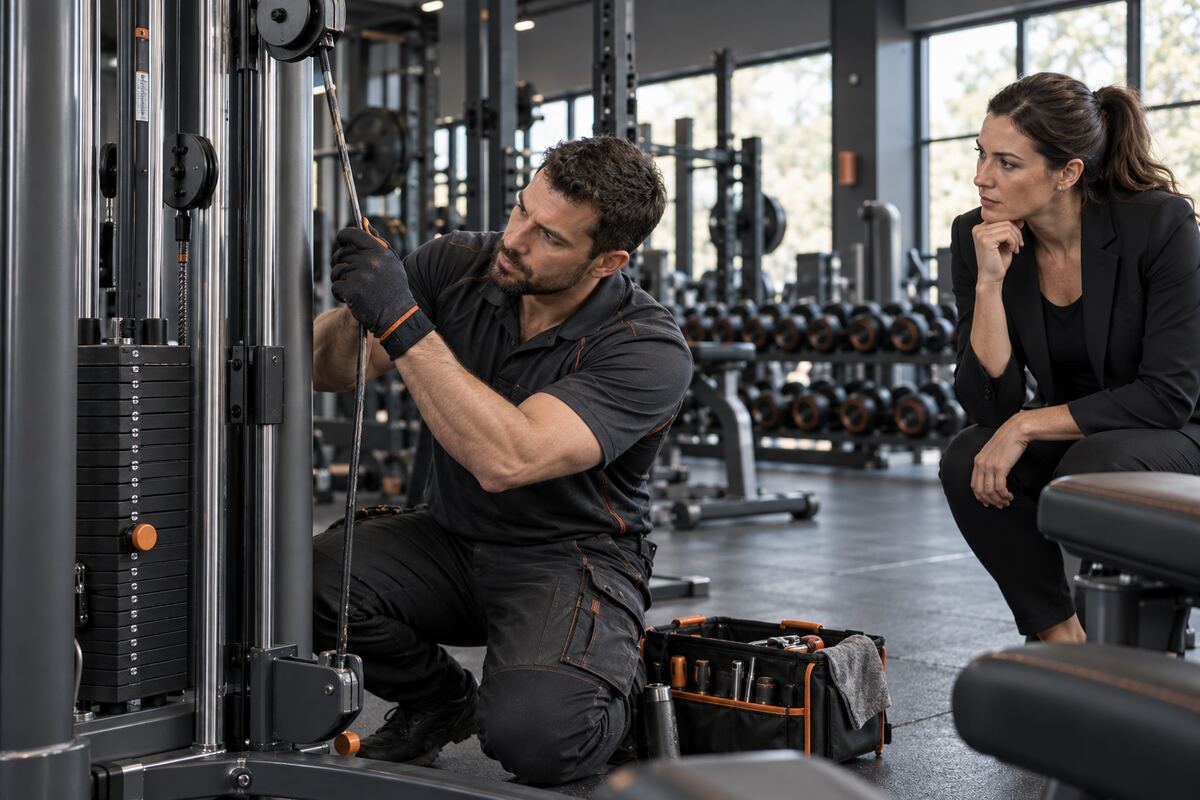
Twenty minutes, same day, same order, before the floor gets busy. Listen to each powered unit through one full cycle, hand-test every adjustment and joint, and look at belt edges, cable seatings, pad seams and matting. Record green, amber or red against the asset identifier with a note a technician could act on.
Where the walk keeps producing ambers on one asset, the question has stopped being maintenance and become the repair-or-replace decision.
Build the Inspection Round From Scratch
- Number every asset. A signal without an identifier is an anecdote; a durable label turns a walk into a record.
- Take a sound and heat baseline. Note how each powered unit sounds and how warm it runs while it is healthy, so change is detectable later.
- Open one complaint channel. One book or one form, machine identifier plus date, checked weekly by the person doing the walk.
- Publish the threshold table. Put green, amber and red where staff can see it, so escalation is a rule rather than a judgment call.
- Book the first four walks. Put them in the staff schedule by name and time; an unscheduled routine is a good intention with no owner.
Commercial Gym Equipment Maintenance Questions Operators Ask
How often should we be inspecting rather than servicing?
Weekly for the walk above, with a deeper hands-on check monthly on high-duty assets. Inspection and service are different activities: inspection finds signals, service acts on them. Facilities that fold the two together inspect only when a technician visits, far too rarely to catch anything early.
Can staff do this, or does it need a technician?
Staff can do all of it. Every signal in the threshold table is detectable by hand, ear and eye without instruments, and the point is triage rather than diagnosis. What staff must not do is repair anything on a load path. Commercial gym equipment maintenance splits into detection, which is internal, and correction, which usually is not.
Which assets deserve the closest attention?
Rank by duty cycle and consequence of failure, not purchase price. A heavily used cable machine with a member under the load matters more than an expensive item used twice a day. The construction cues that predict long life are covered in the signs equipment is built and supported to last.
Does an amber signal justify taking a machine out of use?
Not usually, and doing it routinely will make staff stop reporting ambers at all. Amber exists so a repair is scheduled while the machine still works. The exception is any signal touching a load path or a safety mechanism, which goes straight to red however minor it looks.
Catching It While It Is Still Cheap
Prevention is not a virtue, it is arithmetic. A green signal costs a part and an hour of attention. The same signal caught red costs a callout, a parts wait, an empty floor position and a member who found a workaround. When something breaks anyway, the first 24 hours after a breakdown is a different discipline.