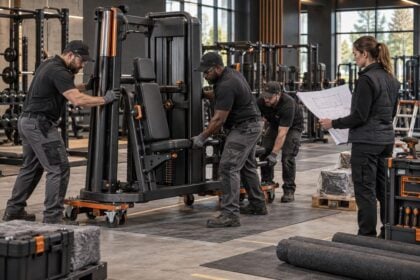


Equipment standardization is usually sold to a multi-site operator as a purchasing argument, and the purchasing argument is real. What rarely gets presented alongside it is the operating cost of the same decision, which lands on people who were not in the sourcing meeting.
- Equipment Standardization Is a Procurement Win and an Operations Constraint
- The Two Standards That Define What Same Spec Means
- The Regional Manager Owns Consistency
- The Service Manager Owns Parts Depth
- The Club Manager Owns the Exception
- The Finance Lead Owns the Replacement Curve
- Where Equipment Standardization Should Stop
- A Standardization Tier Table by Equipment Category
- Five Steps to Set the House Standard Before the Next Refresh
- Accessibility Is Not an Optional Layer
- Operator Questions on Equipment Standardization
- Does equipment standardization actually reduce the total parts spend?
- How do we standardize when the portfolio was acquired piecemeal?
- Should a single-site operator bother with a written spec?
- What breaks an equipment standardization program most often?
- The Standard That Nobody Can Deviate From
Equipment standardization across every club buys volume pricing, one training curriculum and a shallow parts bin. It also removes the local manager’s ability to answer a floor that does not behave like the model club. Both effects are permanent once the standard is signed.
Equipment Standardization Is a Procurement Win and an Operations Constraint
The savings show up immediately and get reported. The constraint shows up in month fourteen, when one site’s members queue at a station that works fine everywhere else, and the answer is that the spec does not permit a second unit.
Neither effect is an argument against equipment standardization. They are an argument for deciding, in advance and in writing, which categories are standardized hard and which are left to the site. That decision belongs with the spec owner named in our coverage of the spec nobody owns between design and purchase.
The Two Standards That Define What Same Spec Means
Before an operator writes a house standard, it is worth knowing what the published ones already cover. ASTM’s Standard Specification for Fitness Equipment, F2276 sets design and manufacturing parameters for indoor fitness equipment intended for users age 13 and above.
F2276 addresses stability and structural integrity, protection of moving parts, guarding of squeeze, shear and crush points, adjustment and locking mechanisms, handgrips and foot support, and load-transmitting components such as ropes, belts, chains and gear drives. It also requires assembly instructions, parts lists, maintenance instructions and warning labels.
That matters for equipment standardization because much of what buyers write into a house spec is already a published requirement. The house standard should be spending its words on what F2276 does not fix.
The Regional Manager Owns Consistency
The regional manager is the person for whom equipment standardization pays first. One spec means one induction script, one set of instructional signage, and a member who can use any club in the region without relearning a machine.
That value is real and it is also the easiest to overstate. Consistency across sites matters most to members who actually visit more than one site, and most portfolios have fewer of those than the standardization case assumes.

The Service Manager Owns Parts Depth
The strongest case for equipment standardization is not the purchase price. It is that a fleet of one model turns a wide, shallow parts bin into a narrow, deep one, and depth is what shortens downtime.
A technician carrying the console board for the one console in the portfolio fixes on the first visit. A technician serving six console generations carries nothing and orders everything. The failure patterns worth stocking against are set out in our piece on the failures treadmills announce weeks early.
The Club Manager Owns the Exception
Every portfolio contains a site that defeats equipment standardization: a ceiling too low for the standard rack, a panel that will not carry the standard cardio row, a membership whose usage skews hard to one category. The panel case is set out in our guide to the breaker count that caps a treadmill row.
A standard with no exception process produces one of two outcomes. Either the site runs equipment that does not suit it, or the manager buys outside the standard and nobody records it. The second is worse, because the parts depth argument quietly stops being true.
The Finance Lead Owns the Replacement Curve
A hard standard has a consequence that finance sees before anyone else. Identical units bought together fail together, and a fleet purchased in one cycle comes due in one cycle.
Staggering the buy protects the capital plan at the cost of some volume pricing. That trade is the one worth modeling explicitly, alongside the timing questions covered in our analysis of the repair log that names the replacement date.
Where Equipment Standardization Should Stop
Not every category rewards a single spec equally. Categories with deep service demands and high failure rates reward standardization most. Categories that are cheap, durable and rarely serviced reward it least.
The table below is the shape of that judgment. It is a starting position for a spec committee, not a ruling.
A Standardization Tier Table by Equipment Category
| Category | Standardize | Reason | Permitted local variance | Who signs an exception |
|---|---|---|---|---|
| Treadmills and powered cardio | Hard | Highest service load; console and board commonality drives first-visit fix rates | Quantity only | Service manager |
| Selectorized strength line | Hard | Cable, pulley and shroud parts are model-specific and consumed steadily | Quantity and station mix | Service manager |
| Consoles and connected hardware | Hard | Software support and firmware versions fragment fastest across generations | None | Regional manager |
| Racks and platforms | Medium | Durable and rarely serviced, but ceiling height and floor plate vary by site | Height and footprint | Club manager plus regional |
| Free weights and storage | Soft | Commodity items; parts depth argument barely applies | Brand and quantity | Club manager |
| Functional and accessory kit | Soft | Programming differs by market and turns over faster than a spec cycle | Full local discretion | Club manager |
| Recovery and stretch equipment | Soft | Category still moving; locking a spec early strands the portfolio on it | Full local discretion | Club manager |
| Accessible-use stations | Hard | Compliance posture should not vary between sites in the same portfolio | Placement only | Regional manager |
Five Steps to Set the House Standard Before the Next Refresh
- Write the exception process before the spec. A standard without a documented deviation route generates undocumented deviations. Name the signer for each category and require the reason in writing.
- Separate the spec from the vendor. Write the standard as performance and service requirements, not as a model number. A spec bound to one model becomes worthless the day that model is discontinued.
- Ask the service manager which parts they carry today. The categories where the technician already stocks nothing are the categories where equipment standardization pays fastest.
- Stagger the purchase deliberately. Decide what share of the fleet is bought in a single cycle, then hold that share whatever discount is offered for taking more.
- Re-open the standard on a fixed date. Set a review interval and put it in the calendar. A standard nobody revisits becomes the reason a portfolio is still buying a superseded console.
Accessibility Is Not an Optional Layer
ASTM’s Standard Specification for Universal Design of Fitness Equipment, F3021 sets additional requirements beyond the referenced ASTM standards, aimed at increasing access and user independence for people with functional limitations or impairments in commercial settings.
F3021 addresses assistive technologies including wheelchairs, walkers, crutches and prosthetics, includes color contrast requirements, and covers wheelchair-accessible design for both manual and powered chairs. ASTM notes that products meeting it are not thereby classified as medical or rehabilitation equipment.
This is the clearest case for standardizing hard. A portfolio whose accessible stations vary site by site has a compliance posture that varies site by site, which is not a position any operator chooses deliberately.
Operator Questions on Equipment Standardization
Does equipment standardization actually reduce the total parts spend?
It reduces the number of distinct parts held rather than the number consumed. The saving is in carrying cost and in downtime avoided when a technician has the part on the van. Operators expecting a lower parts invoice are usually measuring the wrong line and will conclude the program failed.
How do we standardize when the portfolio was acquired piecemeal?
You standardize forward, not backward. Apply the house spec to every replacement and every new site, and let the inherited equipment age out on its own schedule. Retrofitting an acquired club to the standard early destroys the remaining service life you paid for.
Should a single-site operator bother with a written spec?
Yes, though for a different reason. A single site gets no volume pricing, but a written spec still protects the purchase from drift when a salesperson substitutes a model at the quote stage. It also survives a change of manager, which an unwritten preference does not.
What breaks an equipment standardization program most often?
An unmanaged exception route. Once one club buys outside the spec without a record, the parts depth assumption is wrong and nobody knows it until a technician arrives without the part. The failure surfaces as a service problem, not as a purchasing problem.
The Standard That Nobody Can Deviate From
A spec written to eliminate judgment will be worked around by people who need judgment to run a floor. The standards that survive are the ones that name what is fixed, name what is local, and give the exception a signature line rather than forcing it underground. Write the deviation route first, and the standard itself will hold for years. Write it last, and it will be quietly dead within two refresh cycles.