
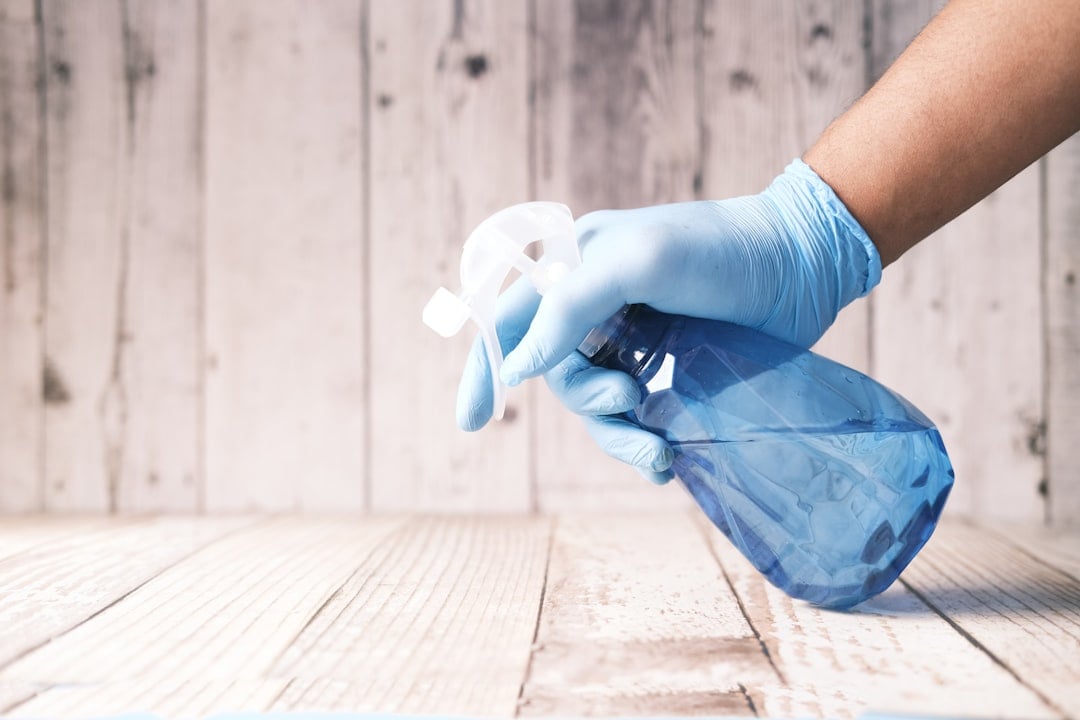

Almost every premature upholstery failure on a club floor is a chemistry problem, and gym equipment cleaning chemicals are chosen by whoever places the janitorial order rather than by whoever signs the replacement invoice.
- Contact Time Is the Whole Argument
- Vinyl and Polyurethane Upholstery: the Surface That Pays for Everything
- Powder-Coated Frames and the Seam Nobody Wipes
- Console Overlays and the Products That Haze Them
- Rubber, Grips and Cable Housings
- Chrome Guide Rods and the Wipe That Becomes a Scratch
- Gym Equipment Cleaning Chemicals and the Dilution Nobody Checks
- A Surface Compatibility Table for Gym Equipment Cleaning Chemicals
- Five Steps to Fix the Wipe-Down Program
- Questions Operators Ask About Gym Equipment Cleaning Chemicals
- Do wipes disinfect as well as sprays
- Will the manufacturer warranty cover chemical damage
- Is bleach ever appropriate on a club floor
- Who should own the product list
- The Cost Shows Up on the Replacement Schedule
The tension does not resolve by picking a gentler product. Disinfection requires a registered product left wet on a surface for a stated period, and that wet period is what the material underneath tolerates several times a day for years.
Work it surface by surface. Each material fails differently, and the failure mode names the part of the wipe-down routine that caused it.
Contact Time Is the Whole Argument
The EPA defines a disinfectant as a substance, or mixture of substances, that destroys or irreversibly inactivates bacteria, fungi and viruses, though not necessarily bacterial spores. That definition comes with a condition attached.
Contact time, in the agency’s words, is the time the product must remain on the surface for it to be effective, and the surface should be visibly wet for the entire contact time. Gym equipment cleaning chemicals applied as a spray-and-immediate-wipe deliver cleaning, not disinfection.
The agency also warns that if a label lacks directions for a specific pathogen, it has not reviewed data on whether the product is safe and effective used that way, and it maintains separate lists by pathogen, including List B for tuberculosis, List G for norovirus, List H for MRSA and List K for Clostridium difficile spores, published with its selected registered disinfectants.
Vinyl and Polyurethane Upholstery: the Surface That Pays for Everything
Upholstery absorbs the cost of the whole program. Repeated wet contact, especially with products never cleared for soft surfaces, shows up first as a loss of suppleness, then as hardening, then as cracking along the stitch line where the material flexes.
The tell is location. Chemical aging appears across the whole panel and at seams; mechanical wear appears where bodies actually contact the pad. A club replacing pads on lightly used machines is looking at a chemical problem, not a traffic problem.
Check what the label lists under use sites and surface types before the product reaches a pad. Gym equipment cleaning chemicals cleared for hard non-porous surfaces are not automatically appropriate for coated fabrics, and the machine maker’s own cleaning guidance usually names what it will warrant.
Powder-Coated Frames and the Seam Nobody Wipes
Frames look indestructible and mostly are, with two exceptions. Chalking and dulling appear where a strong cleaner is used undiluted, and corrosion starts wherever a liquid collects and is never dried.
Collection points are predictable: under seat carriages, inside frame tubes at the weld, at underside bolt heads, and where runoff pools on the bottom rail. Sweat and gym equipment cleaning chemicals do the same work, which is why bottom brackets on group cycles fail before mileage explains it and why a drying pass matters as much as the chemical choice.
Console Overlays and the Products That Haze Them
Screens and membrane overlays are the least forgiving surfaces on the machine and the most frequently sprayed, because they are at eye height and visibly smudged.
Alcohol-heavy and solvent-bearing products haze polycarbonate, lift the edges of printed overlays, and eventually kill the responsiveness of a membrane button. Spray the cloth rather than the console, keep liquid away from bezels and ports, and treat a dead touch zone as a cleaning outcome until proven otherwise.
Members notice this before management does. A hazed screen and a sticky button read as a tired machine, which is the quiet mechanism behind machines that pass every service check and still get skipped.
Rubber, Grips and Cable Housings
Rubber is where damage is most visible and most often blamed on quality. Grips go chalky, rubber-clad weights bloom and crack, and cable housings stiffen.
Solvent content is usually the cause, along with products left to dry on a surface never meant to hold them. Water with a neutral cleaner handles grips; disinfection belongs on surfaces people sweat into. Applying gym equipment cleaning chemicals selectively is where hygiene and asset life stop competing.
Chrome Guide Rods and the Wipe That Becomes a Scratch
Guide rods and chrome shafts need to stay slick, and any residue left on them turns into an abrasive slurry the next time a carriage travels.
A dry wipe followed by the lubricant the maker specifies beats any disinfectant here. Studios running carriage equipment see this earliest, which is why the wear points on a reformer include the rails alongside the ropes.
Gym Equipment Cleaning Chemicals and the Dilution Nobody Checks
Concentrates are the hidden variable. A product mixed by eye is a different product every shift, and the error runs in both directions: too weak to disinfect, or strong enough to damage.
Dosing equipment, marked bottles and a dated mixing log cost almost nothing and remove the whole category of problem. The EPA’s own guidance on safe use runs in six steps, beginning with verifying the registration number on the product and reading the directions for use sites and surface types, then pre-cleaning where the directions call for it, keeping the surface wet for the contact time, using gloves, and storing the product with lids closed, as set out in its six steps for disinfectant use.
Pre-cleaning deserves its own line. Wiping a visibly soiled pad with disinfectant wastes the chemical and the labor, because soil interferes with the action being paid for.
A Surface Compatibility Table for Gym Equipment Cleaning Chemicals
Print this, laminate it, and put it where the bottles live. The right-hand column is what a supervisor should be able to answer without a phone call.
| Surface | Failure from the wrong product | Safer default | Verify on the label |
|---|---|---|---|
| Vinyl upholstery | Hardening, then cracking at the seams | Neutral cleaner, then an approved disinfectant | Surface types listed under use directions |
| Polyurethane pads | Tackiness and color transfer | Product the machine maker names | Whether soft surfaces are covered |
| Powder-coated frames | Dulling and chalking at wear points | Correctly diluted neutral cleaner | Dilution rate and pH |
| Console overlays and screens | Hazing, lifted edges, dead buttons | Damp microfiber, sprayed on the cloth | Alcohol content and screen warnings |
| Printed decals and warning labels | Peeling edges and lost legibility | Wipe around; replace when unreadable | Solvent content |
| Rubber grips and clad weights | Chalking, bloom and surface cracking | Water with a neutral cleaner | Whether rubber is an approved use site |
| Chrome guide rods | Residue, then scoring of the bushing | Dry wipe plus specified lubricant | Whether the product leaves residue |
| Rubber and urethane flooring | Discoloration and slip risk | Flooring maker’s approved dilution | Rinse requirement and dwell time |
| Bolt heads and welds | Corrosion starting under the head | Dry the area after the contact time | Corrosion warnings for metals |
Five Steps to Fix the Wipe-Down Program
This is a one-week project, and it usually reduces both chemical spend and pad replacement in the same year.
- Inventory every bottle on the floor. Record the product, the registration number and the dilution, and remove anything nobody can account for, including decanted mystery bottles.
- Match products to surfaces in writing. One sheet naming which product touches upholstery, which touches consoles and which touches frames, posted where the supplies are stored.
- Fix dosing before training staff. Dosing equipment or pre-measured product removes the largest source of variance, and no amount of instruction beats not asking people to guess.
- Add a drying pass to the closing routine. After the contact time elapses, dry seams, bolt heads and carriage rails, because standing liquid is what converts a cleaning routine into corrosion.
- Photograph six pads quarterly. A dated photo set turns arguments about wear into evidence, and it feeds the cheaper parts that actually decide service life into the replacement plan.
Questions Operators Ask About Gym Equipment Cleaning Chemicals
Do wipes disinfect as well as sprays
Only if the surface stays wet for the stated contact time. A single wipe that dries in twenty seconds on a warm pad has not delivered what the label describes. Wipes are convenient for member self-service and are not a substitute for a staff pass with a product left wet for the full period.
Will the manufacturer warranty cover chemical damage
Generally not. Cracked or hardened upholstery attributed to unapproved products is usually treated as misuse rather than defect. Ask each supplier for its written cleaning guidance and keep it with the asset record, because that document is what a claim will be measured against.
Is bleach ever appropriate on a club floor
On some hard, non-porous surfaces where the label lists them, and rarely on equipment. Sodium hypochlorite products are hard on metals, coatings and soft surfaces, so restrict them to areas the label covers and keep them away from pads, consoles and chrome entirely.
Who should own the product list
One person, usually the operations manager, and not the janitorial supplier. Gym equipment cleaning chemicals get substituted quietly when a distributor changes a line, so the person who approves the order should be the person who checks the label against the surface list.
The Cost Shows Up on the Replacement Schedule
Nobody budgets for chemistry, and everybody pays for it. A club that reupholsters a strength line two years early has spent more on that line than it saved across a decade of cheaper product. Gym equipment cleaning chemicals are an asset-life decision wearing a janitorial label, which is why the product list belongs beside the maintenance plan rather than inside a supply order nobody reads.