
The federal standards governing warehouse material handling are short, old and almost entirely uncontroversial, which is exactly why nobody in this trade reads them.
- Failure Mode One: The Aisle That Shrank
- Failure Mode Two: Stacks That Were Never Blocked or Interlocked
- Warehouse Material Handling Rules Assume Uniform Loads
- Failure Mode Three: The Clearance Sign Nobody Installed
- Failure Mode Four: The Operator Evaluated Four Years Ago
- Failure Mode Five: Housekeeping Treated as Tidiness
- Failure Mode Six: The Rack Leg and the Slab
- What Warehouse Material Handling Costs When It Goes Wrong
- A Six-Point Audit You Can Run This Week
- A Five-Step Sequence to Close the Gaps
- Questions Warehouse Managers Are Asking
- Does warehouse material handling regulation apply to a small distributor
- How often do forklift operators need to be re-evaluated
- Is a training certificate from a previous employer sufficient
- What should a near-miss log actually capture
- The Cheapest Hour in the Building
They are also written in general terms, and general terms map badly onto pallets of plates, crated racks and treadmills that are heavier at one end than the other.
Failure Mode One: The Aisle That Shrank
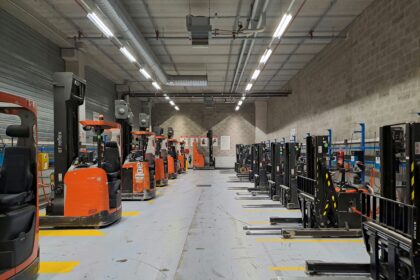
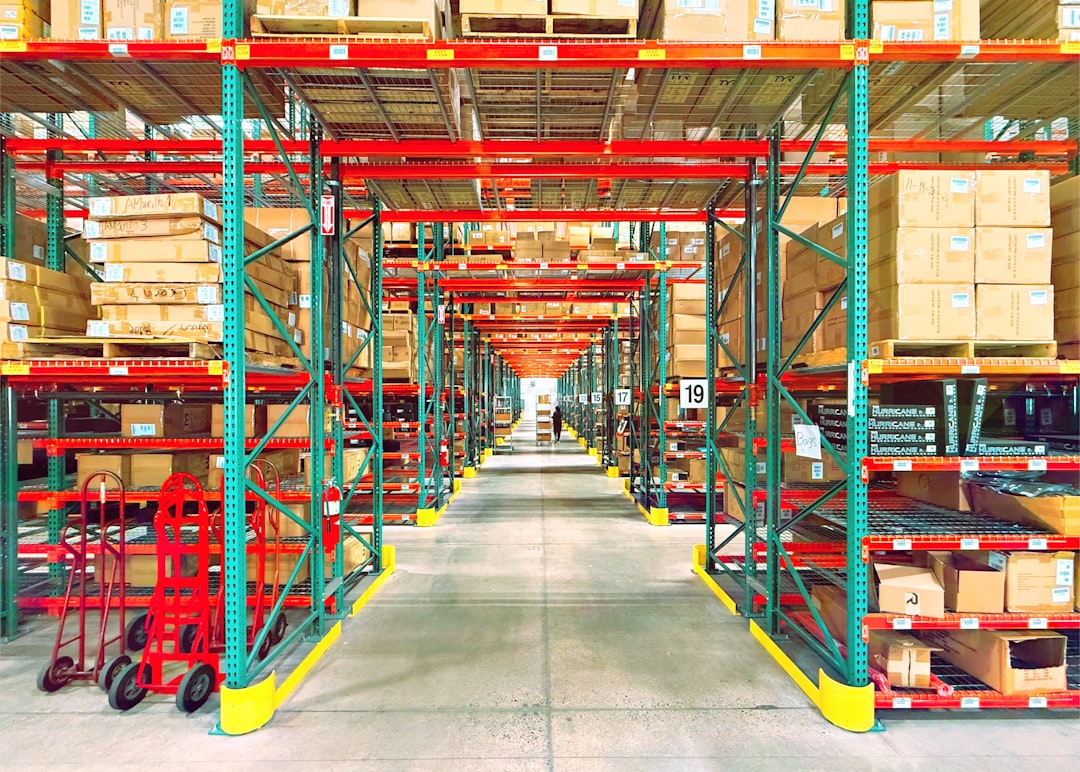
Aisle widths get set once, when racking goes in, and are usually set by eye against whatever truck was on site that week.
OSHA’s general requirement at 29 CFR 1910.176(a) is that where mechanical handling equipment is used, sufficient safe clearances be allowed for aisles, at loading docks and through doorways. The operative phrase is sufficient for the equipment in use, not sufficient on the day the lines were painted.
Fitness inventory makes this harder than ordinary warehouse material handling, because the widest load in the building is rarely the most common one. A crated half rack or a pair of reformer boxes sets the true clearance, and it moves twice a month.
Failure Mode Two: Stacks That Were Never Blocked or Interlocked
The same section requires that storage of material not create a hazard, and that bags, containers and bundles stored in tiers be stacked, blocked, interlocked and limited in height so they are stable and secure against sliding or collapse.
Plate cartons satisfy the letter of that easily and the spirit of it poorly. They are dense, they are small relative to their weight, and a tier that looks stable is carrying far more mass than its footprint suggests.
Warehouse Material Handling Rules Assume Uniform Loads
This is the structural problem with applying general storage guidance to this trade. The rules were drafted around cartons and bags of broadly similar density, and a great deal of what an equipment distributor stores is not that.
Three characteristics break the assumption. Weight concentrated in a small footprint, as with plates and weight stacks. Centers of gravity well away from the geometric center, as with treadmills and cable columns. Crates tall enough that a small angle at the base becomes a large displacement at the top.
Effective warehouse material handling in this trade means treating density and balance as separate inputs rather than reading a carton size and assuming the rest.
Failure Mode Three: The Clearance Sign Nobody Installed
One sentence in the standard reads simply that clearance signs to warn of clearance limits shall be provided. It is among the easiest requirements in the whole of warehouse material handling to satisfy and among the most commonly ignored.
Low points multiply quietly in leased space: a sprinkler main, a mezzanine edge, a rolled-up dock door, a conduit run added by the previous tenant. None of them were there when the operator learned the building. A signed clearance costs a morning and prevents the damage class that our note on freight damage claims describes from the other end.
Failure Mode Four: The Operator Evaluated Four Years Ago
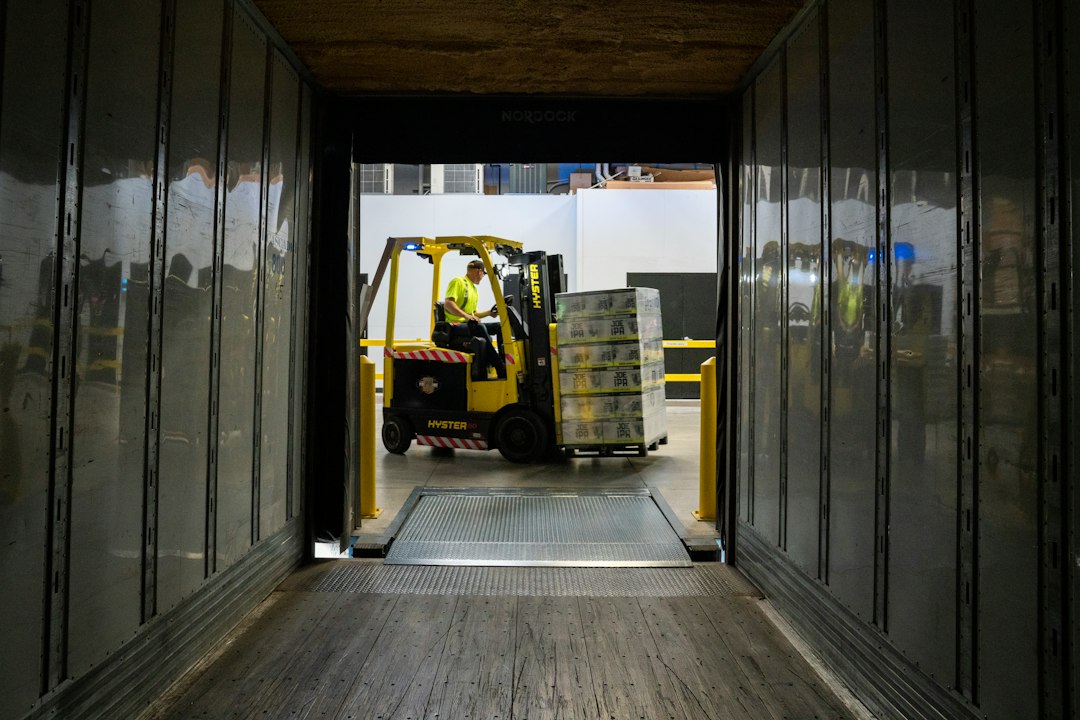
Forklift training is treated in most small warehouses as a one-time event, and the standard does not describe it that way.
29 CFR 1910.178(l) requires that operators complete training before operating independently, that trainees operate only under direct supervision, and that an evaluation of each operator’s performance be conducted at least once every three years. It also requires refresher training when an operator is observed operating unsafely, is involved in an accident or near-miss, is assigned a different type of truck, or when conditions in the workplace change.
That last trigger is the one this trade hits constantly. A distributor that adds a new line, changes rack configuration or takes on taller crates has changed workplace conditions in the sense the standard means, and warehouse material handling competence does not automatically carry across.
Failure Mode Five: Housekeeping Treated as Tidiness
The standard requires storage areas be kept free from accumulation of materials that constitute hazards from tripping, fire, explosion or pest harborage.
In an equipment warehouse the accumulation is specific and predictable: steel banding, shrink wrap, corner protectors, pallet fragments and the foam that comes out of every crate. It arrives faster than anyone plans for, and it collects in exactly the aisles where warehouse material handling turns are tightest.
Failure Mode Six: The Rack Leg and the Slab
Racking transfers its entire load through a handful of base plates, which is the same arithmetic that decides what a training room floor can carry.
A slab rated for general warehouse material handling is not automatically rated for the point loads under a fully loaded upright, particularly once a distributor moves from cartons to plates in the same footprint. This is a question for the racking supplier and, where the answer is uncertain, an engineer. Our note on signing a first warehouse lease covers what to ask before the space is committed.
What Warehouse Material Handling Costs When It Goes Wrong
The visible cost is damaged inventory, and it is the smallest line.
An incident takes the building out of service while it is cleared, puts deliveries behind by days, and consumes management attention during the week it can least be spared. Where an employee is hurt, the cost moves into a different category entirely and stays there for years. Against that, the entire remediation list below is a few hundred dollars and two days of attention.
A Six-Point Audit You Can Run This Week
| Check | Rule it maps to | Acceptable | Needs work |
|---|---|---|---|
| Aisle width against the widest load | 1910.176(a) | Measured with the largest crate on the forks | Set by eye when racking was installed |
| Tier stacking | 1910.176(b) | Blocked, interlocked, height limited | Stacked to fill the available bay |
| Clearance signs | 1910.176(e) | Posted at every low point in the building | None posted, or posted before a retrofit |
| Housekeeping of packaging waste | 1910.176(c) | Scheduled removal, banding cut and binned | Wrap and banding accumulating in aisles |
| Training certification record | 1910.178(l) | Name, training date, evaluation date, evaluator | Verbal assurance that everyone is trained |
| Evaluation interval | 1910.178(l) | Every operator evaluated within three years | Date unknown or older than three years |
| Refresher triggers | 1910.178(l) | Near-misses logged and acted on | Near-misses not recorded at all |
A Five-Step Sequence to Close the Gaps
- Measure the aisle against your worst case, not your average. Put the largest crate you handle on the forks and drive the route. Mark the width that actually works and repaint the lines to match it.
- Write a density rule for plates and stacks. Set a maximum tier height for dense freight that is lower than the rack will physically accept, and post it where the receiving team works rather than in a binder.
- Walk the building for low points and sign them. Sprinkler mains, mezzanine edges, door tracks, retrofitted conduit. This is the single cheapest correction in warehouse material handling and it takes one morning.
- Pull every operator certification record and check the dates. Name, training date, evaluation date and who conducted it. Any record missing a field or older than three years schedules an evaluation this month.
- Start a near-miss log and keep it blameless. The standard treats a near-miss as a refresher trigger, which only works if near-misses are reported. A log that produces discipline produces silence instead.
Questions Warehouse Managers Are Asking
Does warehouse material handling regulation apply to a small distributor
Yes. The general industry standards apply to employers regardless of headcount, and the sections covering storage and powered industrial trucks contain no small-business exemption. State plan states may add requirements on top. A four-person warehouse handling crated racks carries the same obligations as a regional distribution center.
How often do forklift operators need to be re-evaluated
At least once every three years, and sooner whenever a trigger occurs. Unsafe operation, an accident or near-miss, assignment to a different type of truck, or a change in workplace conditions each require refresher training. Rack reconfiguration and new product lines both count as changed conditions, which catches most distributors off guard.
Is a training certificate from a previous employer sufficient
Not on its own. The obligation sits with the current employer to ensure competence in this workplace, on this equipment. Prior training can shorten the process considerably, but an evaluation in your building, recorded with the date and the evaluator’s name, is what the certification record is supposed to show.
What should a near-miss log actually capture
Date, location, what was being moved, what nearly happened and what changed afterward. Keep it to five lines so it gets filled in. The value is not the record itself but the pattern it exposes over a quarter, which is almost always concentrated in one aisle or one product type.
The Cheapest Hour in the Building
None of this is expensive, and that is the uncomfortable part. Signs, paint, a tier height rule and a stack of certification records cost less than a single damaged rack, and every one of them can be completed inside a week. The distributors who run this audit annually are not more cautious than their competitors. They have simply noticed that inventory turns and inventory damage are measured on the same floor, a point our piece on what a pallet position really costs approaches from the other direction.