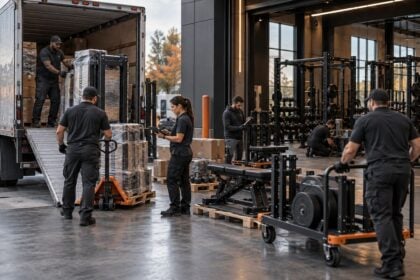

Gym equipment parts imports stopped clearing the easy way in 2025, and the filing rules around them are still moving. The $800 de minimis exemption under 19 U.S.C. 1321(a)(2)(C) has been suspended since August 29, 2025. Customs and Border Protection made that suspension indefinite for every mode of arrival except international mail in an interim final rule published on June 24, 2026 at 91 FR 37789. A further CBP proposal published on October 8, 2026 at 91 FR 64532 would rewrite how the informal entries those shipments now use are filed, and comments on it close on December 7, 2026.
- What changed for gym equipment parts imports
- The October 2026 proposal and what it would require
- Who may file, and why that question reaches dealers
- A landed-cost illustration
- Seven checks before the next parts order
- Records that keep gym equipment parts imports defensible
- Common mistakes
- Does an informal entry still avoid a customs bond?
- Will the $800 threshold come back?
- What to do this month
For a service department that orders motors, consoles, drive belts and bearings from overseas suppliers, gym equipment parts imports are now a landed-cost and lead-time problem rather than a paperwork curiosity. A shipment that once arrived on a manifest release now needs an entry and a party with the legal right to make entry, and CBP has proposed adding a bond requirement on top of that. This briefing sets out what the two rules say, what they do not say, and the checks worth running before the next parts order leaves a supplier.
What changed for gym equipment parts imports
The June 24, 2026 interim final rule (CBP Dec. 26-12, RIN 1685-AA44) amends 19 CFR 10.151 so that the de minimis exemption “is suspended for merchandise arriving via all modes other than through the international postal network.” CBP published a companion rule the same day covering mail shipments. In the preamble to the first rule, CBP states that it “does not, in practice, change the existing suspension of de minimis,” because the exemption had already been suspended administratively.
Two practical consequences sit inside that rule. The release-from-manifest process is no longer available for these shipments, and the Entry Type 86 Test has been suspended. CBP identifies Entry Type 11 as “the main appropriate informal entry method for these shipments,” with formal entry still available where a shipment does not qualify for informal treatment.
The rule also records that the de minimis exemption is scheduled to end by statute, not only by suspension. CBP notes that the One Big Beautiful Bill Act, enacted July 4, 2025, terminates the exemption effective July 1, 2027. Planning on the basis that the $800 threshold returns is therefore not a sound assumption.
The October 2026 proposal and what it would require
The October 8, 2026 document is a proposed rule, not a final one, and nothing in it is in force today. CBP describes its purpose as to “modify filing requirements for informal entries of goods valued at $2,500 or less” and to “establish a new electronic informal entry type for merchandise entering through the mail environment.” The docket is USCBP-2026-0298 and the RIN is 1685-AA38.
Several elements of the proposal matter for gym equipment parts imports. Entry Type 11 would have to be filed electronically “upon or prior to the date of importation,” replacing the current 15-day window after arrival. A Final Deliver-To Party would be required on the entry summary where it differs from the ultimate consignee. Filers would submit the electronic equivalent of CBP Forms 3461 and 7501, so all applicable duties can be assessed.
The proposal would also keep the $2,500 informal entry ceiling and remove the $250 limit that currently applies to Chapter 99, Subchapters III and IV goods, including Section 232 goods. Those goods valued between $251 and $2,500 could then use informal entry. For dealers importing steel-content parts, that is one of the provisions that would widen an option rather than narrow one.
Two cost items deserve attention. All Entry Type 11 and the proposed Entry Type 13 filers would need a basic importation and entry bond, either single-transaction or continuous, and goods would not be released without it. The proposal would also set a $1,000 minimum liquidated damages amount per breach of the listed bond conditions. CBP states that costs begin in 2027, when the rule would take effect if adopted.
Who may file, and why that question reaches dealers
Only parties with the right to make entry may file: owners, purchasers, or an appointed licensed customs broker. A consignee that is neither an owner nor a purchaser, such as a freight forwarder, a carrier, USPS or a foreign postal operator, would have to appoint a licensed customs broker as importer of record. CBP states that the existing exceptions at 19 CFR 143.26(b) for certain duty-exempt shipments are unchanged.
This is the provision that catches service businesses. Where a supplier has been shipping parts and quietly arranging clearance, a dealer who is the purchaser of record may find that it is the party expected to make entry, with the broker relationship, the bond and the recordkeeping that go with it. That question is better settled in a purchase agreement than at a port.
A landed-cost illustration
The figures below are illustrative assumptions chosen to show the method, not industry data. Assume a service department orders 20 replacement console assemblies a year from one overseas supplier, each invoiced at $420, so $8,400 of goods. Assume each arrives as a separate shipment.
| Line | Assumed amount | Annual effect at 20 shipments |
|---|---|---|
| Goods value per shipment | $420 | $8,400 |
| Duty at an assumed 5 percent rate | $21 | $420 |
| Assumed broker fee per informal entry | $35 | $700 |
| Assumed continuous bond, annual | n/a | $550 |
| Total added cost against a duty-free manifest release | n/a | $1,670 |
On these assumed inputs the added cost is just under 20 percent of the goods value, and most of it is fixed rather than proportional to value: $1,250 of the $1,670 is broker fees and bond, against $420 of duty. That is the operative insight: consolidation now pays. Four quarterly consolidated shipments at the same annual volume would carry four broker fees instead of twenty on these assumptions. Recompute the arithmetic with your own duty rate, broker tariff and bond quote before acting on it.
Seven checks before the next parts order
- Confirm who is importer of record. Read the purchase terms and the commercial invoice. If the supplier has been acting as importer, get that in writing, and if your business is the purchaser, expect to be asked to make entry.
- Get a bond in place before you need it. Compare a continuous bond against single-transaction bonds at your actual shipment count. A continuous bond generally makes sense once shipments are frequent.
- Appoint a licensed customs broker. Ask specifically whether they file Entry Type 11, and what data they need from you, and by when relative to the vessel or flight.
- Fix classification and valuation per part number. Build a parts table carrying the HTS classification, country of origin and unit value, and keep it with the part record rather than in an email thread.
- Consolidate. Move from part-by-part ordering to scheduled consolidated shipments, and let your stocking plan rather than the next breakdown set the order quantity.
- Reprice service work that depends on imported parts. Where a quote assumed duty-free parts, the margin assumption behind it has changed.
- Put December 7, 2026 on the calendar. If the proposed filing timing would disrupt your supply, the comment period is the point at which a dealer can say so on the record.
Records that keep gym equipment parts imports defensible
Three records answer the questions an auditor or a broker is most likely to ask. Keep the entry summary and the commercial invoice together for every parts shipment, keep a parts master carrying classification and origin, and keep a log of clearance dates against order dates. That last log is the one that shows whether entry filing is adding days to a repair.
The metrics that tend to move are landed cost per part, clearance days per shipment, and the share of parts orders that travel as consolidated freight. If clearance days are climbing while part numbers stay the same, it is worth checking the data on the entry before assuming a port backlog. Dealers building this discipline for the first time may find the groundwork in our guidance on CPSC certificate eFiling and importer-of-record scope useful, since the same party and data questions recur.
Common mistakes
- Assuming a small invoice value still means no entry. A low value no longer exempts a shipment from entry, although value still decides whether informal or formal entry applies.
- Treating the October 2026 document as settled law. It is a proposal with comments open until December 7, 2026.
- Leaving the importer-of-record question to the freight forwarder, which can lead to a broker being appointed on terms nobody reviewed.
- Quoting service contracts on last year’s landed parts cost. Where parts are priced from a stale cost table, the gap shows up in gross margin rather than in a complaint.
- Ordering reactively, which multiplies per-shipment fixed costs. A critical-parts stocking plan built from failure data and lead times reduces shipment count directly.
Does an informal entry still avoid a customs bond?
Not under the October 2026 proposal. CBP would require a basic importation and entry bond for all Entry Type 11 and Entry Type 13 filings, and states that goods will not be released without it. Today’s practice varies, so confirm the current requirement with your broker rather than with a general rule.
Will the $800 threshold come back?
CBP writes that any change to the suspension will be announced in the Federal Register, and separately notes that the statute terminates the exemption effective July 1, 2027. Treat a return of the threshold as unlikely for planning purposes, and read the two rules yourself: the June 24, 2026 interim final rule and the October 8, 2026 proposed rule on low-value shipments. A customs broker or trade counsel should review how either applies to your own entries.
What to do this month
Settle the importer-of-record question with your two largest overseas parts suppliers, get a bond quote, and move one high-volume part number onto a consolidated schedule as a test. Then reprice the service work that depends on it. Dealers who also hold tariff exposure on finished goods will want to read these filing changes alongside their quote validity and escalation terms, because the two cost lines move on different clocks.