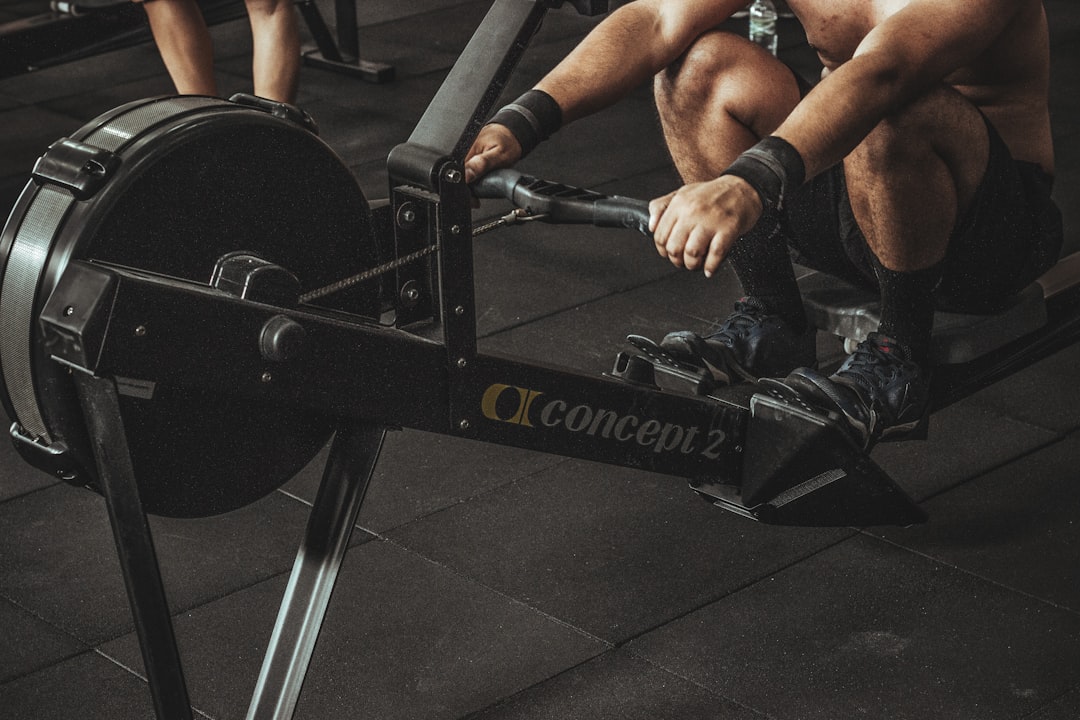

A rower is the most mechanically honest machine on a training floor, which is why commercial rowing machines get bought on the flywheel and lost on everything attached to it.
- The part everyone watches and the parts that actually fail
- Failure one: the chain or belt drive
- Failure two: seat rollers and the monorail
- Failure three: footplates, straps and heel cups
- Failure four: the damper housing and air path
- Failures five and six: handle assembly and console
- Service thresholds for commercial rowing machines by hour band
- Specifying commercial rowing machines for group programming
- A five-year rower routine in five steps
- Questions studios and gyms ask about rowers
- How long do commercial rowing machines last in a busy studio?
- Is a chain drive or a belt drive better on a commercial floor?
- Which rower parts should a studio keep on the shelf?
- What the fifth year actually tests
Members watch the flywheel spin and assume that is the machine, and buyers of commercial rowing machines frequently make the same mistake at the quote stage. The service record says otherwise. Six wear points, none of them the flywheel, decide whether a rower is still worth keeping in its fifth year, and each one fails on its own schedule.
The part everyone watches and the parts that actually fail
Flywheels and their housings rarely fail inside a commercial service life. The load they carry is smooth, the bearing is sealed, and the abuse a rower absorbs is concentrated in the components that move a person rather than the components that resist them.
That gives commercial rowing machines an unusual failure profile among cardio equipment. There is no belt and deck to resurface and no drive motor to burn out, so the budget line looks small until the consumable parts start arriving in pairs.
Failure one: the chain or belt drive
The drive element wears fastest and gets run past its limit most often. Chains stretch, and a stretched chain drags on the sprocket, which changes the catch and raises noise well before it raises a service ticket.
Belt drives move the problem rather than removing it. They run quieter and stretch less, but the failure arrives suddenly instead of gradually. On commercial rowing machines used for group programming, schedule drive inspection by hours rather than by appearance.
Failure two: seat rollers and the monorail
Seat rollers carry grit. Whatever is on the floor ends up on the monorail, and a roller running on a contaminated rail cuts a groove into the rail itself, converting a cheap part into an expensive one.
The tell is audible before it is visible. A seat that clicks at the catch or feels notched on the recovery has rollers past their service point, and the rail underneath is already being damaged.
Failure three: footplates, straps and heel cups
Footplates take the highest cyclic load of any user-facing component and are usually the first part a studio cannot source quickly. Straps fray at the buckle, heel cups crack at the mounting boss, and the adjustment ladder loses its detent under repeated forced settings.
None of this stops the machine, which is exactly why it gets deferred. It does stop members using the machine, and a rower members avoid returns nothing regardless of its mechanical condition. Strap kits are also the cheapest line on any rower parts order, which makes deferral harder to defend than almost any other maintenance decision on the floor.
Failure four: the damper housing and air path
The damper is a moving part in a dusty environment. Chalk, textile fibers and skin dust accumulate inside the housing and across the flywheel cage, which changes the drag curve and makes one machine read differently from the identical unit beside it.
Operators running fleets of commercial rowing machines for scored group work notice this first, because two machines that disagree on a 500-meter split create a coaching problem long before they create a service ticket.
Failures five and six: handle assembly and console
Handles fail at the connector and the strap anchor, not in the grip. A handle dropped repeatedly develops play at the swivel, and that play transmits back into the drive as an uneven catch that coaches will blame on technique.
Consoles fail predictably: batteries, the magnetic pickup, and the contact between pickup and display board. The pickup is the part to carry in stock, because it is cheap, it is the usual cause, and without it the machine is unusable in a scored class.
Service thresholds for commercial rowing machines by hour band
Hour bands beat calendar intervals for commercial rowing machines, because utilization varies enormously between a dedicated studio and a mixed-use floor. The table assumes each machine is logged in hours.
| Wear point | Inspect every | Act at | Symptom that means you are late |
|---|---|---|---|
| Chain or belt drive | 250 hours | 1,200 to 1,500 hours | Noise at the catch, visible sprocket wear |
| Seat rollers | 250 hours | 1,000 hours | Clicking or notchy recovery |
| Monorail surface | 500 hours | First sign of grooving | Seat drags or tracks off center |
| Footplate straps and heel cups | 250 hours | First fraying or crack | Members reset the plate mid-piece |
| Damper housing and cage | 500 hours | Clean rather than replace | Two machines disagree on a split |
| Handle swivel and anchor | 500 hours | Any detectable play | Uneven catch, handle sits crooked |
| Console pickup and battery | 500 hours | First data dropout | Stroke rate disappears mid-piece |
Specifying commercial rowing machines for group programming
Specification decides how much of the list above becomes your problem. Ask whether the monorail is field-replaceable, whether the seat rollers use a standard bearing, whether the damper housing opens without tools, and whether the pickup is sold as a part or only inside a console assembly.
The baseline for guarding, adjustment locking and load-transmitting components is set by ASTM F2276, the Standard Specification for Fitness Equipment, which addresses stability, moving-part guarding, secure adjustment and locking mechanisms, and the ropes, belts and chains that carry load. A rower is almost entirely load-transmitting components, so ask which parts of the machine the maker tests against it.
Demand context matters as well. SFIA’s 2026 Topline Participation Report recorded 250 million Americans taking part in at least one sport, fitness or leisure activity during 2025, with overall inactivity below 20 percent for the first time. Rower demand tracks class programming rather than general participation, so read your own fill rates before scaling a fleet.
A five-year rower routine in five steps
The routine is short because the parts list is short. What it needs is consistency rather than skill.
- Put every rower on an hour meter. Console hours, a class schedule multiplied by machine count, or a clipboard all work. Without hours, commercial rowing machines get serviced on complaint, which is always later than the rail can afford.
- Buy the consumables with the machines. Drive elements, roller sets, strap kits and two pickups per ten machines belong on the original purchase order, where they are cheapest and fastest to obtain.
- Clean the air path on a fixed cycle. Open the housing, clear the cage, and do it on the calendar rather than when a coach complains that one machine reads easy.
- Log split variance across the fleet monthly. Run the same piece on every machine and record the spread. Variance is the earliest fleet-level signal you will get.
- Retire on the rail, not on the flywheel. A grooved monorail with worn rollers is the real end of service life, and it arrives while the flywheel still looks new.
Questions studios and gyms ask about rowers
How long do commercial rowing machines last in a busy studio?
Frames and flywheels routinely pass ten years. The practical limit is the monorail, which in heavy class use typically shows grooving somewhere between year four and year six. Replacing rollers on schedule pushes that out substantially, which is why roller discipline, not flywheel quality, sets the real service life.
Is a chain drive or a belt drive better on a commercial floor?
Neither is categorically better. Chains are cheaper to replace, noisier, and fail gradually enough to be caught on inspection. Belts run quieter with less routine attention but fail abruptly and cost more per replacement. Choose on noise tolerance and on whether your service model catches gradual wear.
Which rower parts should a studio keep on the shelf?
Two seat roller sets, one drive element, one footplate strap kit and two console pickups per ten machines covers the overwhelming majority of downtime events. None of these items is expensive, and all of them take days to arrive when ordered reactively. Studios that hold the shelf stock keep commercial rowing machines out of the service queue almost entirely.
What the fifth year actually tests
Not durability. By year five the flywheel is fine and the frame is fine, and what is failing is whatever nobody scheduled. Fleets that reach year five in usable condition did not buy better commercial rowing machines than the fleets that did not. They counted hours, stocked six cheap parts, and replaced rollers before the rail paid for it. Related reading sits in how sweat ends group cycles early, the cardio costs that skip the quote, the failure signals maintenance logs miss and what downtime really costs.