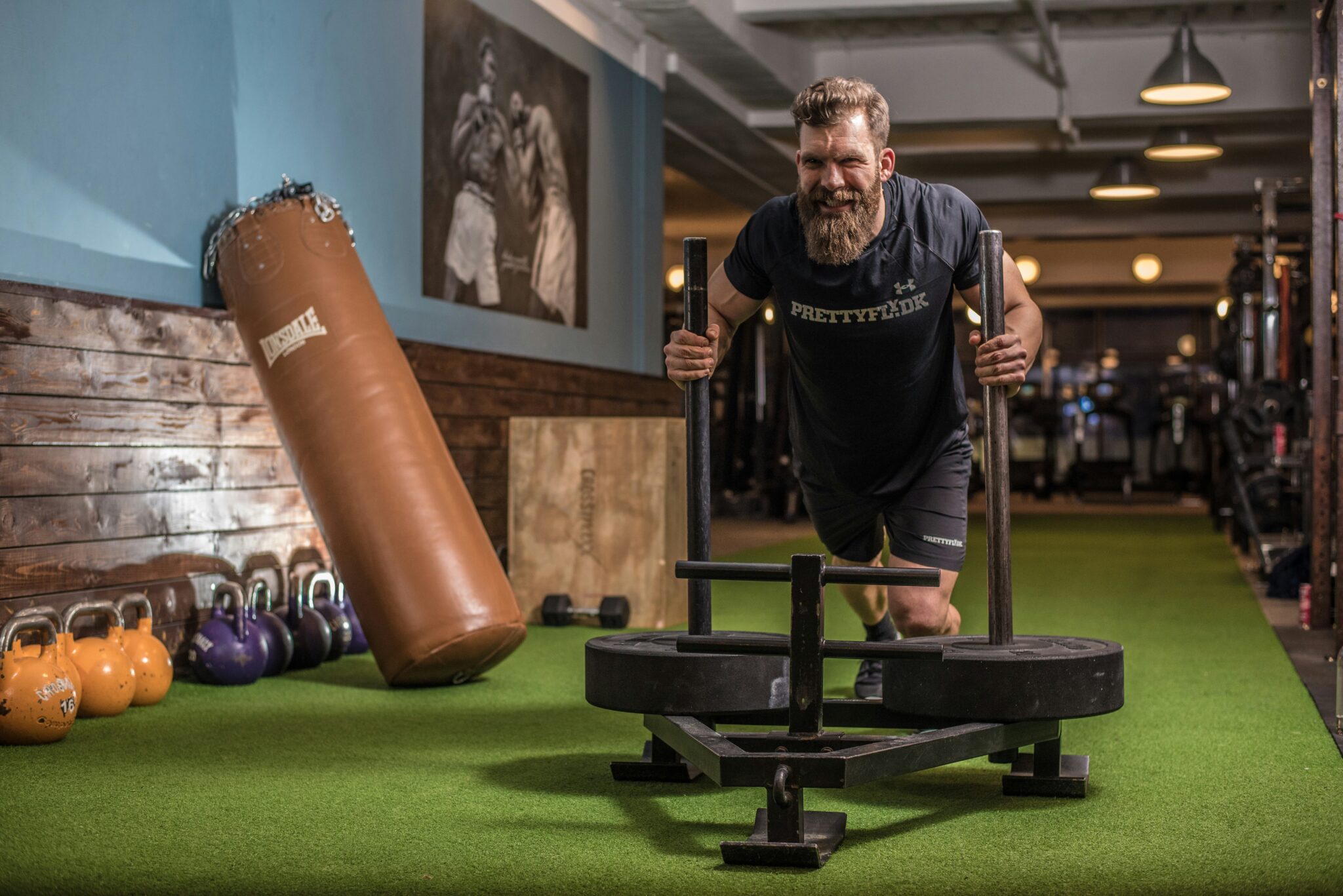

A steel-runner sled loaded with two plates was pushed down the same forty-foot lane roughly eighty times a day, and by the fourth month the seam running the length of that lane had opened wide enough to catch a runner. The pile was barely worn. The failure was in how the gym turf lanes had been laid, not in the fiber anyone argued about at the quote stage.
- The lane fails at the seam, not in the pile
- What gym turf lanes are actually asked to do
- Green: the specification that holds
- Amber: the compromises that still work
- Red: the four choices that end a lane early
- A tier table for gym turf lanes
- Pile height, backing and the sled that decides both
- Where the lane meets the rest of the floor
- Five checks before the turf order goes out
- Gym turf lanes questions operators ask
- How wide should a sled lane be
- Can turf be replaced in one strip instead of the whole room
- Does turf need different cleaning than rubber flooring
- What the four-month lane actually cost
Turf gets specified like carpet and used like a wear surface. Buyers compare pile height and color, sign a square-footage number, and inherit a floor that a sled, a prowler and a hundred pairs of cleated shoes will attack in one direction, every day, along one narrow strip.
The lane fails at the seam, not in the pile
Fiber wear is slow and visible. Seam failure is fast and hidden until it is a trip hazard. A seam that runs parallel to the direction of travel sits under the sled runner for the whole length of every push, and adhesive fatigue there is measured in months rather than years.
The fix is orientation, and it is free at install time. Run the roll so the seam crosses the lane rather than following it, or better, specify a roll wide enough that the lane contains no seam at all. Broadloom turf is commonly supplied in twelve- and fifteen-foot widths, which covers most single and double lanes without a joint.
What gym turf lanes are actually asked to do
A lane does four jobs at once: it takes point loading from a loaded sled, abrasion from the runner, lateral shear from a change of direction, and impact from dropped implements at the ends. Gym turf lanes that are specified for only the first of those will fail at one of the other three.
Demand for that lane is usually downstream of programming, and the sled lane order that follows a race format’s growth is a good example of how a room ends up with turf it never planned for. The end zones matter more than operators expect. Most of the damage in a training lane happens in the first and last ten feet, where sleds are loaded, turned and stopped, and where kettlebells and slam balls get set down hard.
Green: the specification that holds
A green-tier lane is a nylon or high-grade polyethylene fiber at low pile, on a urethane backing, fully glued down over a prepared substrate, with the seam crossing the lane or absent entirely. Line markings are tufted or inlaid rather than painted. Gym turf lanes built this way tolerate steel runners and survive a floor reconfiguration, because the adhesive bond is doing the work rather than the turf’s own weight.
The substrate underneath decides half of it. Turf glued to a slab with residual moisture or an old adhesive layer will release regardless of what the turf itself is made from, which is the same reason worn free-weight floors are decided by the subfloor rather than by members.

Amber: the compromises that still work
Loose-lay turf over a rubber base is amber. It moves, but it can be lifted and replaced in sections, which suits a floor that gets reconfigured seasonally. Double-stick installation with tape at the perimeter and seams is amber for the same reason.
Painted lines are amber. They wear where the sled runs and they will need repainting, but they allow a lane to be renumbered when programming changes. Gym turf lanes in a multi-use room often justify the amber choice deliberately, because the floor’s flexibility is worth more than the extra service life, a trade-off that also governs how a multi-use floor resets between three programs a day.
Red: the four choices that end a lane early
Four decisions reliably shorten a lane’s life. Seam parallel to travel is the first. Infilled turf under a sled is the second, because the infill migrates out of the running strip and leaves a channel. Polypropylene fiber at high pile is the third, because it mats and never recovers under point loading.
The fourth is the one nobody records: allowing a steel-runner sled on turf specified for plastic skis. Gym turf lanes are usually quoted against an assumed sled type, and the assumption is rarely written down anywhere the operator will see it three years later.
A tier table for gym turf lanes
Each row is a decision made at specification, not at install, and each one is cheap to get right before the order goes out.
| Decision | Green | Amber | Red |
|---|---|---|---|
| Seam direction | No seam in the lane | Seam crossing the lane | Seam parallel to travel |
| Fiber | Nylon or high-grade polyethylene | Blended fiber, low pile | Polypropylene at high pile |
| Infill | Non-infill | Non-infill with pad | Sand or rubber infill |
| Backing | Urethane | Latex, sealed edges | Unsealed or unknown |
| Installation | Full glue-down, prepared slab | Double-stick or loose lay | Loose lay over old adhesive |
| Markings | Tufted or inlaid | Painted, scheduled repaint | Painted, no repaint budget |
| Sled type written into spec | Named in the purchase order | Named in the quote only | Never stated |
| End zone treatment | Rubber drop pads at both ends | Pad at the loading end | Turf to the wall |
Pile height, backing and the sled that decides both
Pile height is the number everyone compares and the least useful one on its own. Low pile reduces resistance and wears more slowly under a runner. Higher pile feels better underfoot and drags more, which some programs want deliberately for sled work.
Backing is the number nobody asks for. Urethane backing holds tufts under lateral shear better than latex and tolerates cleaning chemistry better over time. A specification for gym turf lanes that names pile height and omits backing has described the half of the product that members notice and skipped the half that determines how long it lasts. There is no equipment standard to fall back on here either: fitness product standards sit with ASTM Subcommittee F08.30 on Fitness Products, and a training surface is not the machine, so the purchase order has to carry the specification that a standard would otherwise carry for you.
Where the lane meets the rest of the floor
Transitions are the second most common failure point. Turf meeting rubber tile at a flush edge with no transition strip curls, and a curled edge is a hazard before it is a cosmetic problem. Specify the transition detail at the same time as the turf.
Accessibility runs through the same transitions. The U.S. Access Board’s guide to sports facilities requires an accessible route to at least one of each type of exercise machine, with clear floor space of at least 30 by 48 inches, or 36 by 48 inches where the space is enclosed on three sides. Gym turf lanes that squeeze the route past adjacent selectorized machines can compromise that clearance even though the turf itself is nowhere in the standard.
Five checks before the turf order goes out
- Measure the lane, then the roll. If the lane is narrower than the available roll width, specify no seam in it. This is the single highest-value decision in the order.
- Name the sled in the purchase order. Steel runner or plastic ski, and the maximum loaded weight. It changes the fiber and backing recommendation and it protects the warranty conversation.
- Ask for the backing, not just the pile. Urethane or latex, and whether edges are sealed. Get it on the quote in writing.
- Budget the end zones separately. Rubber drop pads at both ends cost less than replacing the first and last ten feet of a lane twice.
- Test the substrate before adhesive is ordered. Moisture and old adhesive residue defeat a good turf specification, and the test is cheap compared with a lifted lane.
Gym turf lanes questions operators ask
How wide should a sled lane be
Wide enough for the sled plus the athlete’s stride path on either side, which in practice means a lane noticeably wider than the sled frame. Two narrow lanes usually serve a floor better than one wide one, because they double throughput at peak without adding length that most rooms do not have.
Can turf be replaced in one strip instead of the whole room
Only if it was installed that way. A loose-lay or double-stick lane can be lifted and replaced in sections. A fully glued run across a whole room cannot be patched invisibly, and dye lots between the original and replacement roll rarely match, so plan the replacement unit at install.
Does turf need different cleaning than rubber flooring
Yes. Turf traps what rubber sheds, so it needs regular vacuuming or sweeping rather than only a damp mop, and disinfectant dwell times matter to the backing adhesive as much as they do to upholstery. The same chemistry cautions that apply to cleaning agents on equipment surfaces apply to a turf backing.
What the four-month lane actually cost
The replacement turf was a modest line item. The closed floor, the rebooked classes and the incident report for the athlete who caught the seam were not. Gym turf lanes are cheap to specify well and expensive to specify carelessly, and almost every decision that separates the two is made before anyone measures a square foot, by a buyer reading a quote that lists pile height and nothing else.