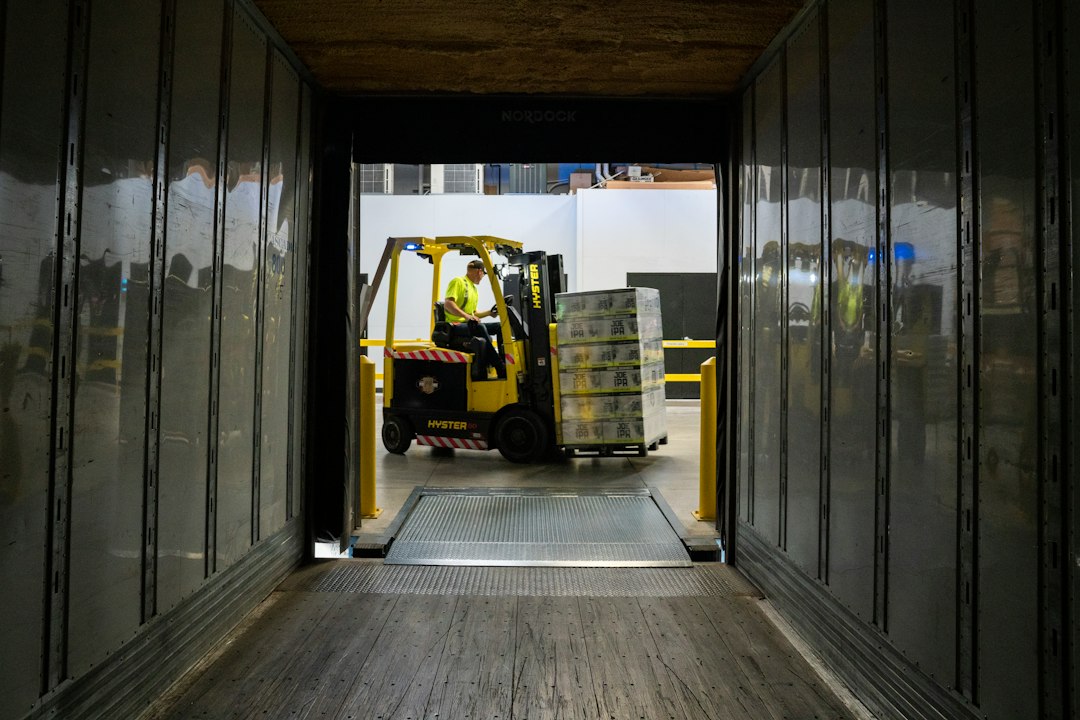

For: Warehouse managers, receiving leads and owners of equipment distributors and dealers that stock inventory.
The decision: What controls the warehouse needs so equipment arrives, is stored and leaves without damage, lost claim evidence or an injury, and which warehouse material handling requirements apply.
60-second answer: Inspect and count at the dock, note damage before the driver leaves, and quarantine damaged goods until the claim is settled. Store plates, stacks and top-heavy crates by their density and balance, not their carton size. Set aisle widths and clearance signs against the largest load you actually move. Keep forklift training and evaluation records with the fields OSHA requires, and re-evaluate operators when conditions change.
Receive it as if a claim depends on it
Every damage claim, warranty question and customer dispute about condition starts at the dock. Make receiving a checklist, not a signature.
- Count against the bill of lading before the driver leaves, by piece and by crate.
- Inspect visible damage to crates, corners, banding and tip indicators where fitted. Photograph labels and damage in place.
- Note shortages and damage on the delivery receipt. Under 49 CFR Part 370, a notation on a delivery or inspection document is evidence but is not, by itself, a filed claim against an interstate motor carrier; the written claim still has to follow.
- Record serial numbers and the storage location at put-away so recall checks and warranty registration are fast later.
- Quarantine damaged stock in a marked area, with packaging retained, until the carrier or supplier has inspected or released it. Selling or discarding it first destroys the evidence.
Concealed damage found at uncrating needs the same treatment and should be reported promptly; see the freight damage claims checklist for the full process.
Fitness freight breaks the uniform-load assumption
General storage rules were written around cartons and bags. Equipment inventory adds three complications: very dense items in small footprints, such as plates and weight stacks; centers of gravity well away from the middle of the crate, such as treadmills and cable columns; and tall crates in which a small lean at the base becomes a large movement at the top. Treat density and balance as separate inputs at put-away, rather than reading the carton size and assuming the rest.
OSHA’s materials handling and storage standard, 29 CFR 1910.176, requires that storage not create a hazard, and that material stored in tiers be stacked, blocked, interlocked and limited in height so it is stable and secure against sliding or collapse. Follow the rack manufacturer’s rated capacities and load signage, and set your own lower tier limits for dense freight where stability needs it. Racking concentrates load at its base plates; if you change from cartons to plates in the same footprint, confirm slab capacity with the racking supplier or an engineer. Battery-powered equipment has its own storage and returns considerations, covered in the lithium battery checklist.
Aisles, clearances and housekeeping
The same standard requires sufficient safe clearances for aisles, at loading docks, through doorways and wherever turns or passage must be made where mechanical handling equipment is used; aisles kept clear and in good repair; clearance signs warning of clearance limits; and storage areas free from accumulations that create tripping, fire, explosion or pest hazards.
- Aisle width: set it against the widest load you move, such as a crated rack or paired reformer boxes on the forks, not the average carton. Drive the route with that load and mark the width that works.
- Clearance signs: walk the building for low points added since you moved in, such as sprinkler mains, mezzanine edges, door tracks and conduit, and sign each one.
- Packaging waste: banding, shrink wrap, corner protectors and crate foam accumulate fastest in the tightest turns. Schedule removal; do not wait for it to be noticed.

Forklift training and evaluation records
The powered industrial truck standard, 29 CFR 1910.178(l), requires that operators be trained and evaluated, that each operator’s performance be evaluated at least once every three years, and that the employer certify training and evaluation with the operator’s name, the training date, the evaluation date and the identity of the person who trained or evaluated. Refresher training is required when an operator has been seen operating unsafely, has been involved in an accident or near-miss, receives an evaluation showing unsafe operation, is assigned a different type of truck, or when a workplace condition changes in a way that could affect safe operation.
That last trigger matters in this trade. Taking on a new line with taller crates, reconfiguring racks or changing the receiving area can all change conditions. A training certificate from a previous employer does not replace the current employer’s evaluation in this workplace.
Warehouse audit
| Check | Source of the requirement | Acceptable | Needs work |
|---|---|---|---|
| Receiving count and damage notes | Carrier claims process; 49 CFR Part 370 | Counted, photographed and noted before the driver leaves | Signed clean under time pressure |
| Damaged-stock quarantine | FEX recommended control | Marked area, packaging retained until release | Damaged units sold or discarded before inspection |
| Serial and location record | FEX recommended control | Recorded at put-away | Found by walking the aisles |
| Aisle width | 29 CFR 1910.176(a) | Tested with the largest load you move | Set by eye when racking went in |
| Tier stacking | 29 CFR 1910.176(b) | Blocked, interlocked, height limited; rack ratings posted | Stacked to fill the bay |
| Housekeeping | 29 CFR 1910.176(c) | Scheduled removal of packaging waste | Wrap and banding in aisles |
| Clearance signs | 29 CFR 1910.176(e) | Posted at every low point | None, or posted before later alterations |
| Operator certification | 29 CFR 1910.178(l)(6) | Name, training date, evaluation date, evaluator | Verbal assurance only |
| Evaluation interval and refreshers | 29 CFR 1910.178(l)(4) | Every operator evaluated within three years; triggers acted on | Dates unknown; near-misses unrecorded |
Keep a short, blameless near-miss log: date, location, what was moving, what nearly happened and what changed. Near-misses are a refresher trigger under the standard, which only works if people report them. The pattern over a quarter usually concentrates in one aisle or one product type.
What to do this week
- Turn receiving into a written checklist: count, inspect, photograph, note, record serials, quarantine.
- Drive the main aisles with the largest crate you handle and repaint lines to the width that works.
- Walk the building for low points and post clearance signs.
- Pull every forklift operator’s certification record and schedule evaluations for any missing a field or older than three years.
- Start the near-miss log.
Continue with FEX
- Choose dealer premises by receiving capacity and occupancy cost
- Map insurance across stock, transit and installation
- Inventory planning: stock, demo or order
FEX editorial guidance: the receiving checklist, quarantine control and audit layout are FEX analysis. Regulatory descriptions summarize the cited federal text; state-plan states may add requirements. This is not legal advice.
Source notes
- 29 CFR 1910.176 — Aisles and clearances, secure storage, housekeeping and clearance signs.
- 29 CFR 1910.178(l) — Operator training, three-year evaluation, refresher triggers and certification contents.
- 49 CFR Part 370 — Motor carrier loss and damage claims; damage notations are not themselves a claim.
Editorial update, October 8, 2026: Added a receiving and damaged-stock quarantine control. Removed an unsupported estimate of remediation cost and time, and reframed the dense-freight tier limit as an internal control beneath the rack manufacturer’s ratings. Regulatory summaries were checked against the current federal text.