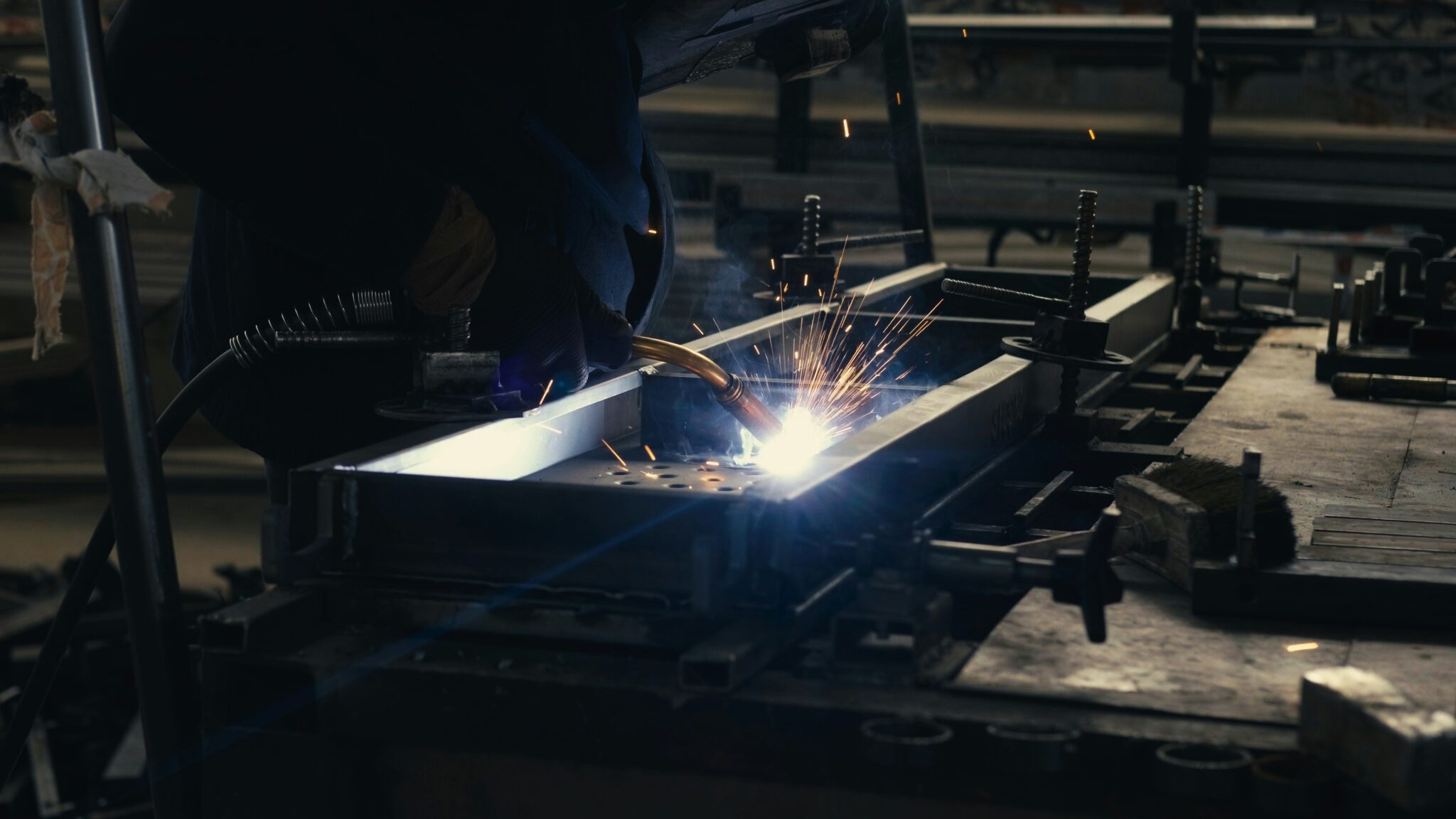

Welding fume exposure limits are easy for an equipment dealer to file under fabrication, a problem for somebody else. That filing is wrong the first time a technician strikes an arc on a cracked stainless guide rod or a chrome-plated weight horn in the back of the shop. The OSHA chromium (VI) standard applies to the work, not to the business card, and the thresholds are low enough that a few hours of stainless welding can matter.
- The two numbers that define welding fume exposure limits for chromium
- Where the chromium in a repair bay comes from
- What welding fume exposure limits require once a shop welds stainless
- A worked example, with the assumptions stated
- Five checks for an equipment service shop
- Controls, in the order OSHA puts them
This is a shop-floor question for refurbishment bays, in-house fabrication benches and any service operation that repairs frames rather than swapping assemblies. The rule is 29 CFR 1910.1026, and the numbers in it are small.
The two numbers that define welding fume exposure limits for chromium
Paragraph (c) of the standard requires the employer to ensure that no employee is exposed to an airborne concentration of chromium (VI) above 5 micrograms per cubic meter of air, calculated as an 8-hour time-weighted average. That is the permissible exposure limit.
Paragraph (b) sets a second, lower number called the action level: a concentration of airborne chromium (VI) of 2.5 micrograms per cubic meter of air, also as an 8-hour time-weighted average. The action level is not a limit on exposure. It is the trigger for monitoring and, at a sustained level of exposure, for medical surveillance. A shop can be fully compliant with the permissible exposure limit and still owe a monitoring program because it sits above the action level.
Paragraph (a) puts the scope at occupational exposures to chromium (VI) in all forms and compounds in general industry, with three exclusions: exposures from pesticides regulated by the Environmental Protection Agency or another federal agency, exposures to portland cement, and, under paragraph (a)(4), situations where the employer has objective data showing that the material or process cannot release chromium (VI) at or above 0.5 micrograms per cubic meter as an 8-hour time-weighted average under any expected conditions of use. That third exclusion is a documentation route, not an assumption anyone gets for free.
Where the chromium in a repair bay comes from
The OSHA fact sheet Controlling Hazardous Fume and Gases during Welding, DSG FS-3647, dated 03/2013, states that “Chromium is a component in stainless steel, nonferrous alloys, chromate coatings and some welding consumables.” The chromium in stainless steel and nonferrous alloys is not hexavalent to begin with. Chromate coatings and some welding consumables can contain hexavalent chromium already. The OSHA Small Entity Compliance Guide for the Hexavalent Chromium Standards, publication 3320-10N, explains that “Cr(VI) can also be formed when performing ‘hot work’ such as welding on stainless steel,” because the heat oxidizes chromium already present into the hexavalent form.
The fact sheet lists what else is in the plume. Metals including aluminum, arsenic, cadmium, chromium, lead, manganese, nickel and zinc. Shielding gases including argon, helium, nitrogen and carbon dioxide. Process gases including nitric oxide, nitrogen dioxide, carbon monoxide, ozone, phosgene and hydrogen fluoride. On health effects it states that “Acute exposure to welding fume and gases can result in eye, nose and throat irritation” and that “Prolonged exposure to welding fume may cause lung damage and various types of cancer.”
What welding fume exposure limits require once a shop welds stainless
The sequence in the rule is determination first, then controls, then surveillance. Paragraph (d)(1) requires the employer to determine the 8-hour time-weighted average exposure for each employee exposed to chromium (VI), using either the scheduled monitoring option at (d)(2) or the performance-oriented option at (d)(3). The compliance guide describes the second option as allowing the employer to determine the exposure “on the basis of any combination of air monitoring data” and other evidence.
Under the scheduled option, paragraph (d)(2)(iii) sets periodic monitoring at least every six months where exposure is at or above the action level, and paragraph (d)(2)(iv) sets it at least every three months where exposure is above the permissible exposure limit. Paragraph (d)(2)(v) allows monitoring to stop for an employee whose result is below the action level once a second sample taken at least seven days later confirms it.
Paragraph (e) requires a regulated area wherever exposure is, or can reasonably be expected to be, above the permissible exposure limit, with access limited to authorized persons. Paragraph (g)(1) lists when respirators are required, including during the periods needed to install feasible controls, during maintenance and repair where controls are not feasible, where all feasible controls are still insufficient to reach the limit, during emergencies, and for operations above the limit on fewer than 30 days per year where the employer elects not to implement controls. Paragraph (g)(2) requires a respiratory protection program under 29 CFR 1910.134.
Medical surveillance is an easy provision to miss. Paragraph (k)(1)(i)(A) ties it to exposure at or above the action level for 30 or more days a year, not to the permissible exposure limit. Examinations are required within 30 days of initial assignment, annually, and at termination, with the schedule and its exceptions set out in paragraph (k)(2).
Housekeeping and records round it out. Paragraph (i)(3)(i) provides that “The employer shall provide readily accessible washing facilities capable of removing chromium (VI) from the skin,” and paragraph (i)(5) prohibits eating, drinking, smoking, chewing tobacco or gum, and applying cosmetics in regulated areas. Paragraph (m) requires air monitoring, historical data, objective data and medical surveillance records to be maintained in accordance with 29 CFR 1910.1020.
| Shop situation | What the standard turns on | Citation |
|---|---|---|
| Exposure at or above 2.5 micrograms per cubic meter, 8-hour TWA | Periodic monitoring at least every six months | 1910.1026(d)(2)(iii) |
| Exposure above 5 micrograms per cubic meter, 8-hour TWA | Periodic monitoring at least every three months, plus a regulated area | 1910.1026(d)(2)(iv) and (e) |
| At or above the action level for 30 or more days a year | Medical surveillance | 1910.1026(k)(1)(i)(A) |
| Above the limit on fewer than 30 days a year, no controls installed | Respirators required for that work | 1910.1026(g)(1) |
| Objective data show release cannot reach 0.5 micrograms per cubic meter | Standard does not apply to that exposure | 1910.1026(a)(4) |
A worked example, with the assumptions stated
The figures here are illustrative assumptions used to show how the thresholds interact. They are not measurements and not typical values for any shop.
Assume a refurbishment bay welds stainless guide rods on two days a week across about 45 working weeks, roughly 90 days a year, and assume monitoring returns a personal 8-hour time-weighted average of 3.1 micrograms per cubic meter for the technician doing it.
That result sits below the 5 microgram permissible exposure limit, so no regulated area is triggered on those facts. It sits above the 2.5 microgram action level, so periodic monitoring at least every six months applies under paragraph (d)(2)(iii). Because the assumed 90 days exceeds the 30-day figure in paragraph (k)(1)(i)(A), medical surveillance applies as well. A shop reading only the permissible exposure limit would conclude it owed nothing and would be wrong on two counts.
Five checks for an equipment service shop
- Write down what you actually weld. Base metal, filler, coating. Stainless, chrome plating and chromate-coated parts are the materials the fact sheet names, and the answer decides whether the standard is in play at all.
- Do the exposure determination before buying equipment. Paragraph (d)(1) requires a determination by one of two routes. A shop that installs a fume extractor without ever sampling still has no determination on file.
- Count welding days per technician per year. The 30-day figure in the medical surveillance trigger is a day count, not an hour count, and it is measured against the action level rather than the limit.
- Fix the hygiene basics first. Accessible washing facilities capable of removing chromium (VI) from the skin and a no eating or drinking rule in regulated areas are cheap, and both are written into the standard.
- File the records where an inspector can find them. Monitoring data, objective data and medical records fall under 29 CFR 1910.1020. The same discipline that keeps injury logs in order is the one that keeps these in order, which is the theme of our guide to which OSHA injury recordkeeping exemptions reach an equipment dealer.
Controls, in the order OSHA puts them
The fact sheet advises employers to “Consider substituting a lower fume-generating or less toxic welding type or consumable,” to use general ventilation while recognizing that outdoor work does not guarantee adequate ventilation, to “Keep fume hoods, fume extractor guns and vacuum nozzles close to the plume source,” and to position workers to avoid breathing the plume. It states that respiratory protection “may be required if work practices and ventilation do not reduce exposures to safe levels,” and notes that the Hazard Communication standard requires information and training for workers on hazardous materials.
That order matters for budgeting. Substitution and positioning cost almost nothing. Local exhaust at the bench is a capital line. Respirators look cheapest on the invoice and are often the most expensive to run properly, because the program under 1910.134 brings fit testing, medical evaluation and recordkeeping with it.
Does an occasional repair weld really count?
The standard applies to occupational exposures, with the exclusions in paragraph (a). Infrequency changes which control options are available rather than whether the rule applies: the compliance guide notes that where a process causes exposure above the limit on 29 or fewer days in any 12 consecutive months, the employer may use any combination of controls including respirators alone, and that the employer bears the burden of proving it. Frequency does not by itself remove the determination duty.
Where does this sit next to other service-bay rules?
It stacks. A technician cutting a frame may also be inside the silica rule when the same job involves drilling into a slab, which our walkthrough of the silica rule and the Table 1 path for anchor drilling covers, and inside the energy-control rules when the machine is being serviced, which is the subject of when the cord-and-plug exclusion to the lockout rule applies. Shops that treat these as one program rather than three tend to keep better records.
None of this makes welding a bad idea in a service business. Frame repair keeps units out of the scrap pile and protects margin on used inventory, a calculation we worked through in pricing refurbishment by bench hours and bay days. It does mean the welding fume exposure limits belong in the shop plan from the first day the bench is installed, rather than the first day an inspector asks for the monitoring file.