
New gym equipment demand is easier to read on a competitor’s floor than on your own, because a new opening is a completed capital decision standing in public. Somebody argued for every square meter in that building, signed for it, and then had to live with the compromises. The evidence is all still there on opening week, before use and wear blur it.
- New Gym Equipment Demand Reads Best in the First Two Weeks
- Before: Decide the Question and Assemble the Public Record
- During: The First Fifteen Minutes Before You Adjust
- During: Count Square Footage by Zone, Never Estimate It
- During: Read What Was Value-Engineered Out
- During: The Service Corridor Tells You the Rest
- During: Staffing Ratios You Can Count Without Asking
- The Observation Sheet
- After: Turning the Sheet Into New Gym Equipment Demand Evidence
- The Evening After the Visit
- Questions Operators Ask Before Walking a Rival Site
- Is visiting a competitor’s opening actually acceptable practice?
- How many sites do I need before this tells me anything?
- What if their format is nothing like mine?
- Should I talk to their staff while I am there?
- What the Walk Actually Buys You
Most operators visit a rival’s new site and leave with impressions: it felt busy, the strength area looked good, the recovery room was smaller than expected. Impressions are not intelligence. What follows is a site-visit protocol with a fixed observation sheet, completed in about ninety minutes as an ordinary paying visitor, producing a comparable record every time you run it.
New Gym Equipment Demand Reads Best in the First Two Weeks
Timing is the largest variable in the quality of the visit. Go too early and the floor is still being finished, with stock in the wrong places and staff improvising. Go three months later and the operator has already moved things, replaced what failed, and filled the gaps that would have told you most.
The window that matters runs from roughly the end of the first week to the end of the second. By then the fit-out is complete and nothing has been corrected yet, which means what you see is what the budget actually approved rather than what the floor eventually needed.
Before: Decide the Question and Assemble the Public Record
Go in with one question, written down. “Did they fund strength at the expense of cardio, and how much?” is a question. “See what they have done” is tourism. A single question determines which parts of the sheet you fill in carefully and which you complete for the record.
Then gather what is already public: the virtual tour, the class timetable, the membership tiers, the recruitment adverts from the previous three months, and the brands named in their marketing. Job adverts are the most underrated of these, because staffing intent is written down honestly in a way marketing never is.
During: The First Fifteen Minutes Before You Adjust
Record your first impressions immediately, then stop trusting them; acclimatization destroys them within a quarter of an hour. Note what you hear at the door, where your eye goes first, and whether the desk faces the floor or the entrance. A prospective member judges on exactly these.
Note what is missing from the entry sequence too. No visible cleaning station, no clear route to the changing rooms, no sightline to the strength area: each is a design decision with a cost attached that surfaces later as operating expense.
During: Count Square Footage by Zone, Never Estimate It
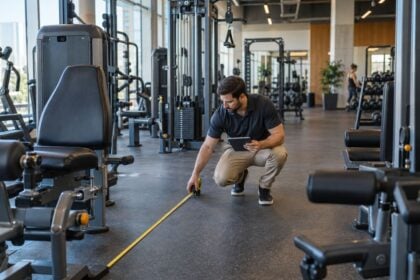
Pace the zones. A normal stride is close enough to a meter for comparative purposes, and comparison is all you need. Count paces along two edges of each zone and record the product: strength, free weights, cardio, functional, recovery, studio and circulation space.
Zone share is the cleanest measure of new gym equipment demand as this operator understood it, because square footage is the resource nobody can fake. A brand that markets itself on recovery and then allocates a single small room has told you where its conviction ended. Zone counts also expose circulation problems a plan view hides, which is where layout clues reveal congestion before it happens, and how the free-weight to machine ratio was really settled.
During: Read What Was Value-Engineered Out
Every fit-out is cut somewhere between concept and opening, and new gym equipment demand is partly defined by what survived those cuts. Look at flooring transitions, mirror coverage, storage for accessories, cable management, lighting in the corners rather than the center, and whether the racks are anchored or freestanding.
Look also at the mix within a bank of machines. A row of eight identical units usually means a volume deal; a row of eight mixed units means a specification built around member need or a budget assembled from more than one source. Neither is wrong, but they describe different buying behavior and different levels of new gym equipment demand conviction.
During: The Service Corridor Tells You the Rest
Walk behind the equipment where you can do so legitimately. Service access exposes a fit-out budget honestly, because no photographer covers it. Check clearance behind cardio units, whether power comes from floor boxes or cables run to a wall, and whether anything already sits on a temporary surface.
Note the floor condition and transitions while you are there. Uneven surfaces, cable runs across walkways and hard-to-clean junctions become both a safety cost and a service cost, which is why the OSHA guidance on walking-working surfaces is worth having in mind as a general standard for what good looks like.
During: Staffing Ratios You Can Count Without Asking
Count bodies on the floor, not on the payroll. Record how many staff are visible in each zone, what they are doing, and whether anyone is stationed in the free-weight area at all. A floor with nobody in strength has made a staffing decision that will show up in equipment condition within a year.
Note the induction offer at the desk and whether classes are running in a studio that could have been floor space. Staffing intensity is the running cost that decides whether an equipment mix was affordable at all, and it is the half of new gym equipment demand that never appears on a quote.
The Observation Sheet
Take this in on one page. Complete every row on every visit so that visits are comparable to each other rather than to your memory of them.
| Record | How to capture it in the room | What it indicates | Common misread |
|---|---|---|---|
| Zone square footage | Paces along two edges, multiplied | Where conviction actually went | Judging by visual impact rather than area |
| Units per zone | Straight count, note duplicates | Volume deal versus specified mix | Reading brand consistency as quality |
| Bank composition | Identical or mixed models in a row | How the deal was assembled | Assuming mixed means unplanned |
| Value-engineering marks | Mirrors, storage, lighting, flooring joints | Where the budget ran out | Blaming taste for what was a cost cut |
| Service access | Clearance behind units, power routing | Whether service was designed in | Ignoring it because members never see it |
| Staff on the floor | Count by zone, note activity | Running cost of the chosen model | Counting the desk as floor coverage |
| Studio versus floor split | Paced area plus timetable density | Revenue model behind the fit-out | Treating an empty studio as spare capacity |
| Recovery allocation | Room count, area, and booking method | Whether recovery was funded or gestured at | Equating marketing prominence with spend |
| Accessory and storage provision | Racks, bins, and what is on the floor | Whether the operator planned for churn | Reading tidiness on opening week as a system |
After: Turning the Sheet Into New Gym Equipment Demand Evidence
The sheet is worthless until it is compared. One visit gives you a snapshot; three visits to different formats in the same quarter give you a distribution, and that is where the reading of new gym equipment demand becomes something you can defend in a budget meeting.
Convert each row into a statement about money, because that is the form in which new gym equipment demand travels into a budget. “They allocated roughly a fifth of the floor to functional training and staffed it with nobody” is a finding. So is “they anchored every rack, which means they expect to keep this layout.” Findings, not impressions, are what survive the walk back to the car. Comparing them against what your own members are already telling you through their floor behavior is where the two datasets earn their keep together.
The Evening After the Visit
- Write the sheet up before you sleep on it. Detail decays faster than anyone expects, and a photograph you took of a corner will not remind you why you took it. Transcribe within a few hours, while the reasoning is still attached to the observation.
- Convert every row into a money statement. Each observation becomes a sentence about what was funded, what was cut, or what will cost them later. Rows that resist conversion were the wrong things to record.
- Mark the two decisions you would not have made. Then argue the opposite case honestly. If you cannot construct their reasoning, you have not finished reading the site.
- Compare against your own zone allocation. Use the same pacing method on your own floor so the numbers are genuinely comparable, then note every gap larger than a fifth in either direction.
- File it as a dated record. A single visit is an anecdote; a folder of them across two years is a trend line. Operating practice guidance such as the Health & Fitness Association’s facility best practices gives you a neutral yardstick to score the file against.
Questions Operators Ask Before Walking a Rival Site
Is visiting a competitor’s opening actually acceptable practice?
Walking in as a paying visitor or on an advertised guest pass is ordinary trade behavior and entirely above board. What is not acceptable is misrepresenting who you are, entering staff-only areas, photographing members, or approaching their team under a false pretext. Observe what any member could observe, and the record stays clean.
How many sites do I need before this tells me anything?
Three in a quarter, across different formats, is where patterns separate from personality. One visit describes one operator’s taste and budget. Three describe what the local market is currently willing to fund, which is a far more useful reading of new gym equipment demand.
What if their format is nothing like mine?
That is often the more valuable visit. A format unlike yours shows what different assumptions produce on comparable rent, and the contrast makes your own defaults visible. Record the same rows regardless, because the reading of new gym equipment demand sits in the allocation, not in whether you would copy the room.
Should I talk to their staff while I am there?
Ask only what any prospective member would ask, and record the answer as marketing rather than fact. Staff on opening week repeat the brief they were given. That brief is evidence of intent, but it belongs in a different column from what you counted yourself.
What the Walk Actually Buys You
A competitor’s opening displays a full capital decision at no cost to you. Ninety minutes with a fixed sheet turns that display into a comparable record of what a local market funded, refused to fund, and ran out of money for. Repeat it three times a year and you will read new gym equipment demand from evidence rather than from rumor. Choosing a distributor who can hold the schedule is a good deal easier once you know what those schedules produced elsewhere.