
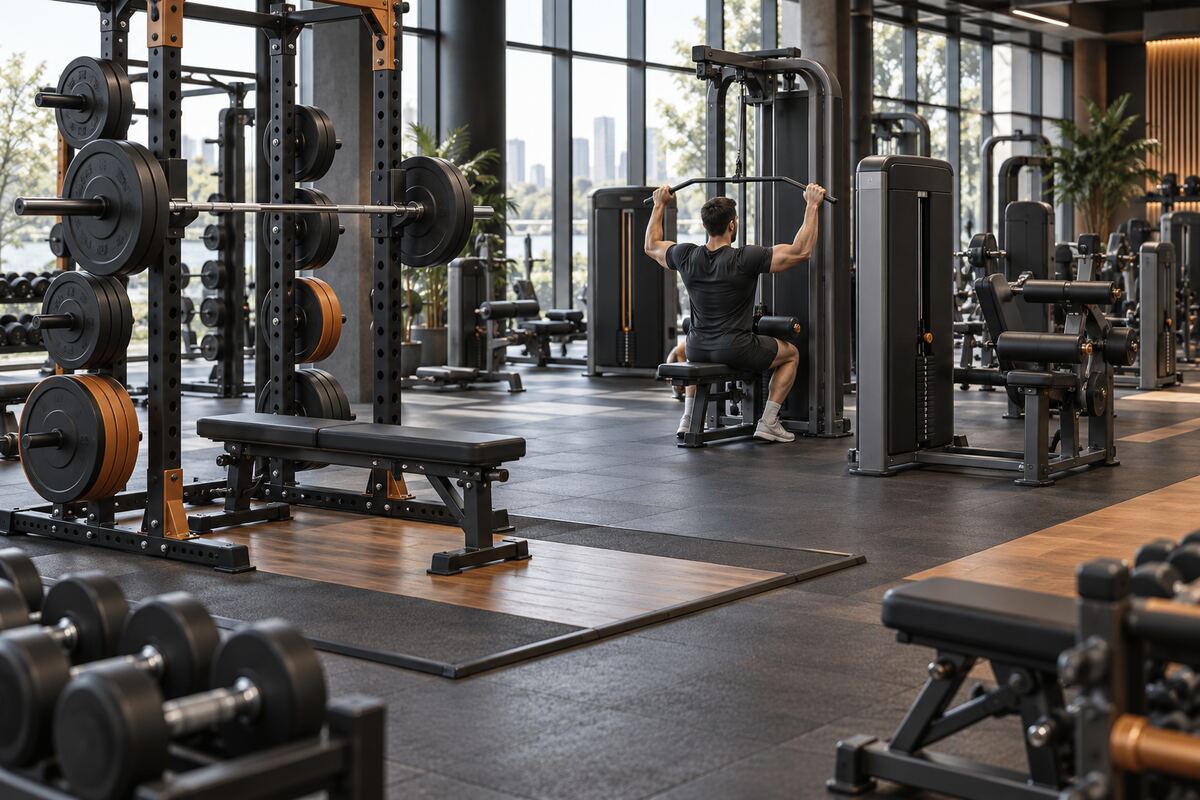

The free weights vs machines question is usually settled by preference, and preference is the weakest evidence available. Somebody on the team lifts, somebody else does not, and the ratio drifts toward whoever argued last.
- Step one: measure the split you already have
- Occupancy is the reading, not inventory
- Branch one: is the floor at capacity at all?
- Branch two: which side is holding the queue?
- Branch three: is it the mix or a handful of stations?
- The free weights vs machines decision table
- Modeling a ratio change before you buy
- What each member segment needs from the split
- Before the next quote goes out
- Free weights vs machines: what operators ask
- What ratio should a general-membership gym aim for?
- How many observation sessions are enough?
- Does adding free weights reduce machine demand?
- When is the ratio not the problem?
- Where the ratio settles
There is a better input sitting on the floor already: how long each station is actually occupied during the hour the building is busiest. That number turns an opinion into a decision tree with branch points you can defend to a finance committee. This piece is only about that decision — the ratio, the readings behind it, and the model you run before changing it.
Step one: measure the split you already have
Count stations, not pieces. A half rack is one station. An eight-station cable jungle is eight. A dumbbell run counts as the number of people who can work in it simultaneously without colliding, which is usually fewer than the rack length suggests.
Write the totals as a plain ratio: free-weight stations to machine stations, selectorized and plate-loaded counted as machines. The free weights vs machines split you quote and the one you actually own are rarely the same number.
Occupancy is the reading, not inventory
Inventory tells you what you bought. Occupancy tells you what the floor is doing. Take the busiest hour of the busiest three days, and for each station record the minutes it is in use, including the minutes somebody is resting on it between sets.
Divide by the minutes observed to get a station occupancy percentage. Then average by type. Two numbers come out of that: free-weight occupancy and machine occupancy, both for the same hour. Everything downstream in the free weights vs machines decision hangs off the gap between them.
Branch one: is the floor at capacity at all?
If both readings sit below 55 percent at peak, the floor is not short of stations and buying more will not help. Queues that members complain about in that situation are usually caused by two or three specific stations, not by the mix.
If either reading exceeds 80 percent at peak, the floor is genuinely constrained during that hour and the free weights vs machines split becomes a live purchasing question. Between 55 and 80 percent, keep measuring for another month before spending.
Branch two: which side is holding the queue?
Subtract the lower type occupancy from the higher one. A gap under 10 percentage points means both sides are working equally hard and the ratio is broadly right; add capacity proportionally or not at all.
A gap of 10 to 25 points marks a soft imbalance, usually fixable by moving stations or changing what sits next to what. A gap above 25 points is a hard imbalance: one side is carrying the floor while the other absorbs space that is not earning. That is the point at which the free weights vs machines ratio itself needs to change.
Branch three: is it the mix or a handful of stations?
Before concluding the free weights vs machines ratio is wrong, look at the spread within each type. If machine occupancy averages 40 percent but three machines sit above 85 and the rest below 25, the problem is a bad selection rather than too many machines.
The same test applies to free weights. One overloaded flat bench beside four idle benches is a placement and quantity problem inside the free-weight side. Ratio changes are expensive and slow; station-level corrections are neither, so exhaust them first.
The free weights vs machines decision table
Read your two occupancy figures, find the row, and take the action beside it. Peak hour means the single busiest hour, not a daily average.
| Free-weight occupancy | Machine occupancy | Reading | Action |
|---|---|---|---|
| Under 55% | Under 55% | Not capacity constrained | Fix placement, buy nothing |
| 55-80% | 55-80% | Balanced and loading up | Re-measure monthly, plan proportional growth |
| Over 80% | Under 55% | Hard imbalance, free-weight side | Convert machine floor area to racks or platforms |
| Under 55% | Over 80% | Hard imbalance, machine side | Add selectorized stations, review free-weight footprint |
| Over 80% | Over 80% | Whole floor constrained | Capacity case, not a ratio case |
| Wide internal spread | Any | Selection problem | Replace the idle stations before changing the ratio |
| Any | Wide internal spread | Selection problem | Audit stack increments and adjustment range |
| High at open, low at peak | Low at open, high at peak | Segment split by time of day | Schedule coaching, not capital |
Modeling a ratio change before you buy
A ratio change is a swap, so model it as one. Take the floor area the outgoing stations release, subtract the working footprint of what replaces them, and check whether the new stations fit without borrowing from a walkway. That accounting is where most ratio plans quietly fail, and it is the same discipline behind planning the strength floor as a whole room.
Then re-run the occupancy arithmetic with the new station counts, holding total demand constant. If the projected occupancy on the relieved side lands between 55 and 75 percent, the change is sized correctly. If it lands below 45, you have overbought.
One more constraint belongs in the model. A ratio that balances on paper still has to be run by staff on an ordinary Tuesday, and the Health & Fitness Association’s best practices for operating a fitness facility set out the supervision, cleaning and resetting load a denser floor adds. Removing machine types entirely can shift that load without anyone costing it.
What each member segment needs from the split
Segments read the same floor differently. New members and returners need guided range of motion and a visible starting point, which machines provide and an empty platform does not. Experienced lifters need loadable, repeatable stations and space to set up.
Members training around an injury or a limitation often need both: a machine to keep loading a pattern safely, and free weights for the patterns that are still available to them. Older members and rehabilitation-adjacent users tend to sit on the machine side but move across as confidence returns, which is why an all-or-nothing ratio decision punishes somebody in every case. The pull toward plate-loaded strength sits in the middle of that spectrum rather than at one end.
Before the next quote goes out
- Fix the station count. Recount both sides as simultaneous working positions and write the real ratio down before anyone quotes anything.
- Run three peak-hour observations. Record in-use minutes station by station on the three busiest days, including rest between sets.
- Calculate the gap. Average occupancy by type, subtract, and place the result against the decision table rather than against an opinion.
- Test for a selection problem. Look at the spread inside each type and correct idle stations first, since that fix is cheaper than a ratio change.
- Model the swap on paper. Check the released area against the incoming working footprints, then project occupancy after the change and confirm it lands in the mid range.
Suppliers respond differently to a request framed this way. A quote built on measured occupancy invites a conversation about sizing rather than about product families, and it makes the question to ask before approving an upgrade much easier to answer.
Free weights vs machines: what operators ask
What ratio should a general-membership gym aim for?
There is no universal number, which is why the measurement matters. Aim instead for a split where peak-hour occupancy on both sides lands in the mid range and the gap between them stays under ten points. If your floor achieves that at four to six, that is your correct ratio.
How many observation sessions are enough?
Three peak hours across three different busy days is usually enough to expose a hard imbalance. One session can be distorted by a class finishing or a single group of members. If the three readings disagree by more than fifteen points, keep observing before making a purchasing decision.
Does adding free weights reduce machine demand?
Rarely by as much as expected. Members who prefer machines mostly keep using them, so the free weights vs machines split usually shifts demand at the margin rather than transferring it wholesale. Model any change assuming most existing usage stays where it is, and treat any transfer you do see as a bonus.
When is the ratio not the problem?
When both types sit under 55 percent at peak, when the internal spread inside a type is wide, or when the pattern differs sharply by time of day. Those are placement, selection and scheduling problems. Ratio changes will not fix any of them, and the sector guidance on when health clubs should buy new equipment assumes planned reinvestment rather than reactive buying.
Where the ratio settles
A floor with the right split does not feel balanced so much as unremarkable. Nobody waits noticeably longer on one side, staff stop fielding the same complaint, and both halves of the room look busy in the same photograph. Free weights vs machines is arithmetic rather than philosophy, and the same arithmetic explains why members walk past machines that work perfectly well.