
For: Operators adding plate-loaded stations to a strength floor, and the dealers who quote them.
The decision: How many plate-loaded stations to order, where they go, and what plate storage to specify so the plates have somewhere to live between sets.
60-second answer: Trend surveys do not size an order. ACSM’s 2026 survey of about 2,000 fitness professionals ranked traditional strength training seventh; it measures professional opinion, not equipment sales or plate-loaded demand. Size the order from waits by movement pattern on your own floor, then get storage per station in writing, because it varies by model. Life Fitness lists six integrated storage horns on the Hammer Strength Plate Loaded Iso-Lateral Incline Press, an 1,800-pound load rating on the Linear Leg Press, three pairs of horns on the HD Elite iD Half Rack, and 1,000 pounds of capacity on its Olympic Weight Tree. Count plates left off storage at close before and after the installation.
What the trend data does and does not show
Reading strength equipment trends is a reasonable place to start a plate-loaded order and a poor place to finish one. ACSM’s list of top trends for 2026, announced October 22, 2025, ranked traditional strength training seventh; wearable technology was first. The list comes from a survey of about 2,000 health and fitness professionals, published in ACSM’s Health & Fitness Journal. It shows what professionals expect to matter. It does not show:
- Equipment sales, orders or category share.
- Whether plate-loaded, selectorized or free-weight stations are gaining on any particular floor.
- How many stations a facility needs, or which movements.
Dealers deciding whether to carry a new plate-loaded range face a different question, covered in evaluating a new plate-loaded equipment line. Operators need local evidence, from the same peak-hour counts used to decide free weights vs machines.
Quantity: count waits by movement pattern
List the movement patterns members train on the strength floor, such as leg press or squat, hinge, incline press, row and pulldown. For each pattern, record which stations serve it. Then, during peak-hour observation rounds at a fixed interval you choose, record whether each station is in use, whether anyone is waiting, and whether a member who found it busy moved to another station for the same pattern.
Read the result by pattern. A pattern with repeated waits and one station is a candidate for a second unit. A pattern whose stations sit idle at peak is a candidate for fewer. Whether your members substitute within a pattern or switch to a different one is something the log shows; it should not be assumed. One unit each of many movements and two units of the movements members repeat are both defensible plans, and the log decides between them.
Plate storage: get capacity per station in writing
Every loaded station needs storage within reach of its loading position; the loose-plate count at close shows whether it has enough. Storage varies by model, so ask for it station by station. As published by Life Fitness (accessed October 2026):
- Hammer Strength Plate Loaded Iso-Lateral Incline Press: “6 integrated weight plate storage horns.”
- Hammer Strength Plate Loaded Linear Leg Press: an “1,800 lb (816 kg) load rating,” with each weight rod able to take up to ten 45-pound plates. The product page also states a minimum door width of 45 inches.
- Hammer Strength HD Elite iD Half Rack: three pairs of weight horns as standard, with a storage depth of 21 inches, and a maximum training weight of 855 pounds.
- Life Fitness Olympic Weight Tree: six horns holding up to sixteen 45-pound and eight 35-pound plates, 1,000 pounds in total, on a 27-by-23-inch footprint.
The comparison that matters is between the loads members actually put on a station at peak and the storage within reach of it; a load rating is a structural limit, not a storage target. Where peak loads exceed nearby storage, plates will be taken from elsewhere, including the neighboring station’s horns. Size storage from your plate inventory by denomination and the loads members actually use at peak, which your counts can show, and put storage on the order as its own line rather than accepting an accessory as supplied. Plate thickness varies by product, so the number of plates a horn holds depends on the plates you buy; see urethane vs rubber plates.
Loose plates are also a housekeeping question. OSHA’s walking-working surfaces rule, 29 CFR 1910.22, requires employers to keep places of employment, passageways and walking-working surfaces clean and orderly, to keep surfaces free of hazards, and to inspect them regularly. It protects staff; member safety is a separate premises question for your insurer. HFA’s layout guidelines (September 2022) call for “defined storage space with corresponding signage for loose equipment.”
Placement, live area and access
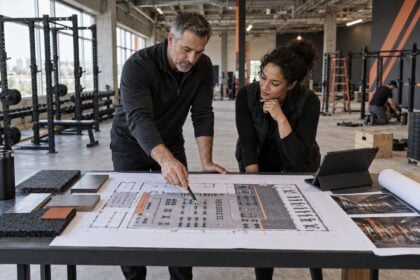
Placement is cheap to get right on paper and expensive to fix once stations are bolted down. Draw each station’s live area, the loading lane on the plate side and the storage position before the order is final. Put delivery dimensions on the survey too: the Linear Leg Press page’s 45-inch minimum door width is the kind of figure that belongs in a delivery site survey.
Under the ADA Standards, at least one of each type of exercise machine and equipment must have a clear floor space of at least 30 by 48 inches, positioned for transfer or for use by an individual seated in a wheelchair, on an accessible route. Clear floor spaces at exercise equipment may overlap. Each new type of plate-loaded station adds one to that plan.
Sightlines and grouping are operating choices to test, not rules. If you believe a station is underused because members cannot see it, log its hourly occupancy before and after a move.
| Quote line | Acceptable answer | Needs work |
|---|---|---|
| Storage on each station | Number of horns, position relative to the loading side, plate fit | “Storage available” |
| Separate plate storage | Model, horn count and rated capacity, placed within reach of named stations | Accessory “as supplied” |
| Load rating | Rated load per model, in writing | Not stated |
| Space in use | Manufacturer live area or clearance per model | Frame footprint only |
| Delivery | Minimum door width and crated dimensions | Assumed to fit |
| Accessible clear floor space | At least 30 by 48 inches at one of each type, positioned for transfer, on an accessible route | Not drawn |
| Quantity | Waits by movement pattern from peak-hour rounds | A catalog bundle |
| Housekeeping baseline | Loose-plate count at close, before and after installation | No baseline |
Triggers you set: a loose-plate count at close, or a number of rounds with waits at one pattern, that prompts more storage or a second station. Red flags: storage left off the quote; peak loads with no matching storage nearby; quantities copied from a bundle; a new station type with no accessible clear floor space drawn.
What to do this week
- Count plates left off storage at close for a week, with a photo each night, to set a baseline.
- List movement patterns, the stations that serve each, and waits recorded in peak-hour rounds.
- Get horn counts, storage capacity, load rating, live area and minimum door width for every model on the quote.
- Draw loading lanes, storage positions and one accessible clear floor space for each type.
- Repeat the loose-plate count after installation and adjust storage to the result.
Continue with FEX
- Rack attachment compatibility checks
- Comparing pendulum squat machines
- Planning clear floor space and routes
FEX editorial guidance: the counting method, order check and triggers are FEX analysis. Specifications are as published by Life Fitness for the named models; confirm them against the spec sheet for the configuration quoted. Manufacturer instructions control assembly, anchoring and loading. This is not legal advice; confirm accessibility and workplace safety obligations with your architect, insurer or counsel.
Source notes
- American College of Sports Medicine: The Future of Fitness: ACSM Announces Top Trends for 2026 (October 22, 2025) — Ranking of traditional strength training, survey size and publication.
- Life Fitness: Hammer Strength Plate Loaded Iso-Lateral Incline Press (accessed October 8, 2026) — Integrated storage horns.
- Life Fitness: Hammer Strength Plate Loaded Linear Leg Press (accessed October 8, 2026) — Load rating, weight rod capacity, minimum door width.
- Life Fitness: Hammer Strength HD Elite iD Half Rack (accessed October 8, 2026) — Weight horns, storage depth, maximum training weight.
- Life Fitness: Olympic Weight Tree (accessed October 8, 2026) — Horns, plate capacity, footprint.
- OSHA: 29 CFR 1910.22, Walking-working surfaces (accessed October 8, 2026) — Employer housekeeping and inspection duties.
- Health & Fitness Association: 21 Best Practice Guidelines for Fitness Facility Layout & Design (September 13, 2022) — Defined, signed storage for loose equipment.
- U.S. Access Board: Moving Forward: Access to Inclusive Fitness Equipment (July 14, 2021) — One of each type; 30-by-48-inch clear space and accessible route.
- eCFR: 36 CFR part 1191, appendix D, technical requirements (accessed October 8, 2026) — Section 1004.1 positioning and overlap.
Editorial update, October 9, 2026: Removed the composite “two floors” narrative, unsourced claims about sightlines, staff reports, movement depth and storage rules, and a shared stock photo. Added manufacturer storage and load figures for named Life Fitness models, ACSM’s 2026 trends survey with its limits, and OSHA, HFA and ADA references.