
Sit on a commercial weight bench in a showroom, push a thumb hard into the edge of the pad about two inches in from the seam, and you have run most of the test that the purchase order will never run. The foam either pushes back or it gives. On a busy floor that difference shows up in month eight as a dished pad, a split seam and a member who moves to the station next to it.
- Start with traffic, not with the catalog
- Number one: pad density and the way it fails
- Number two: frame gauge, and what it does not tell you
- Number three: the adjustment mechanism nobody tests in the showroom
- Footprint decides how many a commercial weight bench floor can hold
- Thresholds by traffic tier
- Standards give you less than buyers expect
- Checks to run before a commercial weight bench order is signed
- Buyer questions on commercial weight benches
- Are flat benches or adjustable benches the better buy?
- Does a heavier bench always mean a better one?
- How often should pads be replaced on a busy floor?
- The bench outlives the quote that bought it
Benches are the highest-traffic strength product in any club and the one buyers spend the least time specifying. A rack gets a site visit and a floor-load calculation. A bench gets a line on a quote, a color and a quantity, and the eight competing models in front of the buyer look interchangeable because the photographs are taken from the same angle.
Start with traffic, not with the catalog
The first decision is not which bench. It is how many sets per day a commercial weight bench station will see, because that number sets every threshold behind it. A Pilates studio with four members an hour and a 24-hour club with a queue at the flat bench are buying different products with the same name.
Traffic tiers also decide whether a commercial weight bench is a consumable or a capital item. At low volume the frame outlives three sets of upholstery and the buying question is pad replaceability. At high volume the adjustment mechanism becomes the limiting part and the buying question changes completely.
Number one: pad density and the way it fails
Pads fail in two ways and only one is visible. Compression set, where foam stops recovering its shape, happens quietly and shifts load onto the frame and the user’s spine. Seam splitting is the visible one, and it is the one members report by not sitting down.
The buying check is replaceability rather than durability. Ask whether the pad is bolted or bonded, whether tops are sold separately, and what the lead time is on a replacement in the same color. A commercial weight bench with a bonded pad is a bench you replace whole, and our tiering of when upholstery gets replaced covers what that costs across a floor.
Number two: frame gauge, and what it does not tell you
Gauge is the number every commercial weight bench spec sheet quotes and almost nobody verifies. It matters, but it is a poor single indicator, because weld quality, gusseting and the geometry of the uprights decide as much about rigidity as wall thickness does.
Ask for the gauge in writing on the quote rather than accepting it from a brochure, and ask what changed if a price came down between quotes. Substitution happens at the frame before it happens anywhere visible. Check the finish at the same time, since the coating process behind a frame fails on the same edges the plates hit.
Number three: the adjustment mechanism nobody tests in the showroom
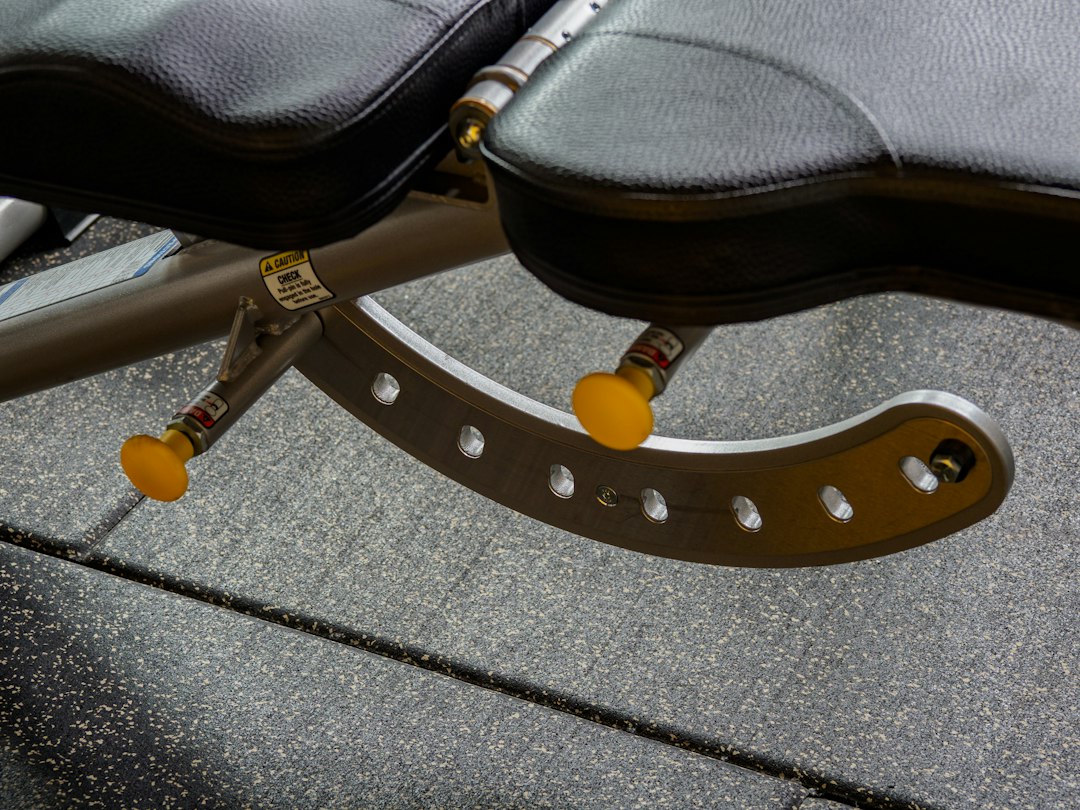
Adjustment is the part members break. A pop-pin that a single user cycles twice a week behaves nothing like the same pin cycled forty times a day by people who do not line up the holes carefully. Ladder adjustments fail differently, usually by wearing the notch rather than the pin.
Test it the way the floor will. Change the back pad angle ten times in a row while seated, at an awkward angle, without looking down. Anything that requires two hands and a clear line of sight will be forced, and forcing is what bends brackets on a commercial weight bench.
Footprint decides how many a commercial weight bench floor can hold
Nominal dimensions are not the number that matters. A bench needs working clearance on both sides for a spotter and for plate loading, and adjacent stations need it too. Buyers who plan from catalog dimensions consistently end up with one more bench than the floor can actually use, which is the pattern described in our look at where crowding on a strength floor begins.
Storage is the other half of the footprint question. Benches that roll and stack free up group training space in a room that doubles as a class floor, but wheels and handles add cost and a failure point. A fixed bench in a multi-use room gets dragged, and dragging is how floor damage starts.
Thresholds by traffic tier
The specification does not change in kind between a studio and a busy club. It changes in where the acceptance line sits, and writing that line down before the quotes arrive is what makes eight similar models comparable.
| Specification line | Low-traffic studio | Busy club floor | Why the threshold moves |
|---|---|---|---|
| Pad firmness | Comfort-weighted foam acceptable | Firm foam that does not bottom out under edge load | A bottomed pad transfers load to frame and user |
| Upholstery | Standard vinyl | Heavier vinyl, double-stitched seams | Seam splits are the first visible failure |
| Pad attachment | Bonded pad acceptable | Bolt-on pad with separately sold tops | Field replacement instead of whole-bench replacement |
| Frame gauge | Manufacturer standard | Stated in writing on the quote | Easiest specification to substitute quietly |
| Adjustment | Pop-pin acceptable | Ladder or assisted mechanism rated for daily cycling | Adjustment is the part members break |
| Incline positions | Fewer steps acceptable | True flat, multiple inclines, decline option | Missing angles push traffic onto other stations |
| Footprint | Nominal dimensions | Nominal plus clearance on both sides | Clearance, not the bench, sets the station count |
Standards give you less than buyers expect
There is a general standard, and it is worth reading before assuming it settles a dispute. ASTM F2276, Standard Specification for Fitness Equipment, covers indoor equipment intended for users age 13 and above and addresses stability, edges, corners and tube ends, guarding of moving parts, squeeze, shear and crush points, adjustment and locking mechanisms, handgrips and foot supports, load-transmitting components, and intrinsic, extrinsic and endurance loading, along with documentation requirements including parts lists and stated weight restrictions.
What it does not do is rank two benches for a buyer. Fitness products sit under ASTM subcommittee F08.30, and conformance is a floor rather than a differentiator. A commercial weight bench that meets the general specification can still have a pad that dishes in a season, which is why the buyer’s own threshold table does the real work.
Checks to run before a commercial weight bench order is signed
- Write the traffic assumption at the top of the inquiry. State sets per day per station so suppliers quote against use rather than against price.
- Press-test every sample pad at the edge, not the center. Edges carry the load when someone sits down sideways, and that is where compression set starts.
- Cycle the adjustment ten times while seated. Do it without looking, because that is how it will be done on the floor at seven in the morning.
- Get gauge, pad specification and warranty terms onto the quote itself. A brochure is not a contract document and a substitution is hard to argue afterward.
- Confirm replacement pad lead time and color matching. Ask for the part number before the order, not after the first split seam.
Buyer questions on commercial weight benches
Are flat benches or adjustable benches the better buy?
Most floors need both, and the ratio follows programming rather than price. Flat benches have no adjustment mechanism to break and survive heavy traffic well, so they belong near the dumbbell rack. Adjustable units earn their place near cable stations and in smaller rooms where one station has to cover several angles.
Does a heavier bench always mean a better one?
Weight correlates with rigidity but it is not the same thing. A well-gusseted frame in lighter material can outperform a heavier one with poor welds, and a heavy bench that cannot be moved is a liability in a multi-use room. Judge stability by loading the seat and pushing laterally, not by lifting one end.
How often should pads be replaced on a busy floor?
By condition rather than by calendar. Replace when the foam stops recovering its shape overnight or when any seam opens, because both change how load reaches the frame. Floors that log pad condition during routine service catch it earlier and avoid the period where members simply avoid the station.
The bench outlives the quote that bought it
A commercial weight bench is bought in a spreadsheet row and then lived with for years in the busiest corner of the room. The specification lines that seem fussy at purchase, pad attachment above all, are the ones that decide whether year four is a parts order or a capital request. Floors that get this right also tend to get the surface underneath right, because the two wear together.