
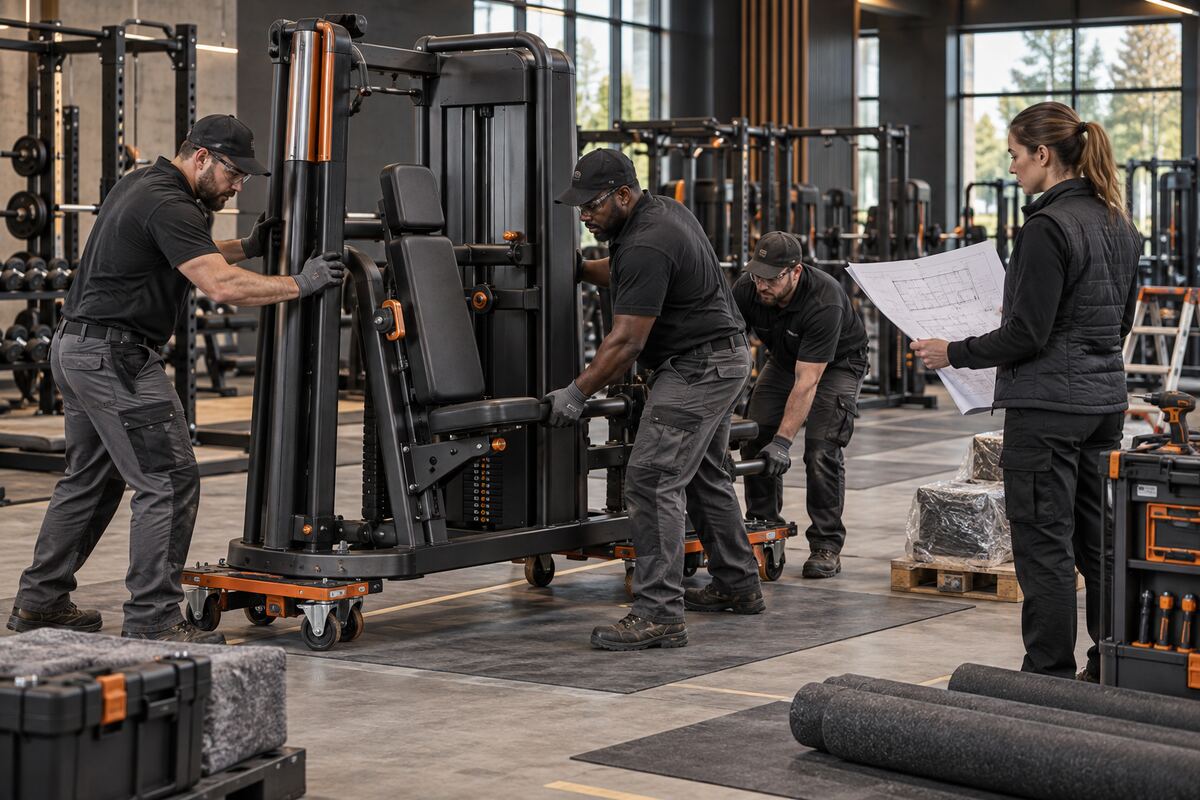

A gym equipment installation team is not a team in any organizational sense. It is a group of people who have never worked together, employed by four or five different companies, sharing a building for one day, with no common manager and no shared incentive beyond finishing.
- Your gym equipment installation team is mostly not your staff
- The lead installer owns the sequence and the clock
- The helpers own the carry, and the damage you argue about later
- The trades who are not the installer: electrician and flooring crew
- The operator’s decision-maker owns yes and no
- The distributor’s project contact owns everything that is not on site
- Briefing a gym equipment installation team in fifteen minutes
- Subcontracted crews and the competence you cannot see
- Supervising without blocking, and settling a dispute on the day
- Before the crew arrives
- Questions operators ask about the crew
- How many people should a gym equipment installation team have?
- Can my own staff help carry equipment?
- What if the installer and the electrician disagree on a position?
- Should I use a local crew or the manufacturer’s crew?
- What a good crew leaves behind
Operators tend to plan the equipment and the schedule carefully and then leave the people to sort themselves out. That is the part that decides whether the day runs. What follows is about the individuals on the floor, what each one owns, and how an operator gets a decision out of them without becoming the bottleneck.
Your gym equipment installation team is mostly not your staff
Count the badges on a typical opening. The lead installer works for the distributor or for a specialist subcontractor. The helpers may be agency.
The electrician answers to the main contractor. The flooring crew answers to somebody else again. Your own staff are usually two people and a set of keys. A gym equipment installation team assembled that way has no shared history to fall back on when something does not fit.
That matters because instructions do not travel sideways between companies. Anything you say to a helper has no contractual weight; anything you say to the lead installer does. Knowing which conversations bind and which do not is most of the skill here.
The lead installer owns the sequence and the clock
This is the only person on the gym equipment installation team with a full picture of the build. They decide unloading order, staging positions, which units get assembled first and where the crew loses time. Their single most valuable habit is walking the route and the floor before anything is unwrapped.
What you should expect from them: a stated plan for the day, a named finish time, and an early warning when the plan stops being achievable. What you should not expect is for them to solve a site problem that belonged to the site-readiness work due in the month before delivery. A lead installer can absorb one surprise on arrival, not six.
The helpers own the carry, and the damage you argue about later
Most avoidable damage happens in the twenty meters between the liftgate and the final position. Skids, dollies, protection boards, corner guards and enough hands for the weight are what separate a clean carry from a scratched frame and a scuffed floor edge.
Watch the first three carries and you know how the day goes. Crews that put protection down before they start rarely need it retrospectively; crews that improvise the first carry improvise all day.

The trades who are not the installer: electrician and flooring crew
The electrician owns the last meter of power, which is the meter nobody drew properly. Their job on the day is not energizing a board; it is confirming that final connections sit where the machines actually stand. An electrician who turns up without the placement plan will connect to the drawing rather than the floor.
The flooring crew own the surface everybody else stands on, and they own the cure date. That date is the most common single cause of a rescheduled install, so it belongs in writing from the flooring contractor, not in a verbal reassurance passed along by a third party.
The operator’s decision-maker owns yes and no
This is your role, or a person you delegate it to, and the only role on site that cannot be subcontracted. Field conditions will not match the drawing somewhere. Somebody has to decide, that hour, whether a rack shifts 200mm, whether a substitution is accepted, and whether a marked unit is refused.
The requirement is presence and authority in the same person. A decision-maker reachable only by email is a decision-maker who is not there. If you must delegate, delegate in writing and tell the whole gym equipment installation team who now holds the pen.
The distributor’s project contact owns everything that is not on site
Missing parts, replacement units, warranty questions, a crate that never left the depot: none of these can be solved by anyone standing on your floor. The distributor’s project contact is the route to all of it, and their value is measured in response time rather than friendliness.
Ask for a named individual and a mobile number before the day, not a shared inbox. This is one of the practical differences between a supplier and a partner, and it shows up in what owners actually remember about a supplier long afterward.
Briefing a gym equipment installation team in fifteen minutes
Do it once, standing up, everyone present, before the first crate moves. Cover six things: who holds decisions, where welfare and waste points are, which routes are protected, the finish time, how to raise a problem, and what “done” means.
Say the finish time out loud. A gym equipment installation team that has not heard a stated end to the day will pace itself against the crate count instead. The table below is what you check each role against before and during it.
| Role | Answers to | Must produce on the day | Competence signal | Warning sign |
|---|---|---|---|---|
| Lead installer | Distributor or install subcontractor | A sequenced plan and a signed placement confirmation | Walks the route before unwrapping anything | Starts unwrapping before walking the floor |
| Installation helpers | Lead installer | Damage-free carry and a complete parts count | Protection down before the first carry | Improvised skids, no floor protection |
| Electrician | Main contractor or operator | Load-tested connections at final machine positions | Arrives holding the placement plan | Asks where units go after they are anchored |
| Flooring crew | Main contractor | Cured, protected surface and a written cure date | Offers cure evidence unprompted | “It will be fine by then” |
| Operator’s decision-maker | Operator | Same-day yes or no on moves and substitutions | On site for the whole window | Reachable only by email |
| Distributor’s project contact | Distributor | Parts, replacements and off-site escalation | Answers inside an agreed response time | Only contactable through a shared inbox |
| Network owner | Operator | Consoles online and reporting before sign-off | Credentials tested before the crew asks | Onboarding booked for the following week |
| Cleaning and handover crew | Operator | Member-ready condition, packaging removed | Booked inside the same window | Booked for the next morning |
Subcontracted crews and the competence you cannot see
Distributors subcontract installation routinely, and there is nothing wrong with it. The risk is that the brand you vetted is not the brand carrying your equipment. Ask directly, before the order: who physically installs, are they employed or subcontracted, and who carries the insurance if a unit is damaged in the building.
The network owner deserves the same scrutiny, because connected consoles join your facility network permanently. The NIST Cybersecurity for IoT Program sets out the questions worth asking about connected devices before somebody puts thirty of them on your wireless.
Ask for the same gym equipment installation team across a multi-phase project. Familiarity with your building is worth more than a lower day rate. The vetting questions that matter here overlap heavily with the checks worth running on a distributor before opening day.
Supervising without blocking, and settling a dispute on the day
Broader operating practice for facilities is well covered by the Health & Fitness Association’s facility best practices, but supervision on install day has its own rules. The failure mode operators fall into is hovering. Standing over a crew slows them and produces cautious, defensive answers.
Supervise at the boundaries instead: the pre-start brief, a walk at mid-morning, a walk after lunch, and the close-out. Between those, be reachable and out of the way.
Disputes on the day are almost always about scope, not competence. Somebody has assumed the other party is doing something. Settle these by fact and in writing, not by seniority.
Write the decision down, name who made it, timestamp it, and send it to both companies before the crew leaves. A verbal agreement between two subcontractors evaporates the moment there is an invoice.
Before the crew arrives
- Ask who is physically installing. Employed or subcontracted, how many people, and whether the same crew returns for later phases. Get it in writing at order stage.
- Name your decision-maker and publish it. One person, on site for the whole window, with the authority to approve a field move without a phone call.
- Collect a name and mobile number for every role in the table. Circulate one gym equipment installation team contact sheet to all companies two days before, not on the morning.
- Confirm the trades who are not the installer. Electrician holding the placement plan, flooring cure date in writing, network credentials issued and tested.
- Book the fifteen-minute stand-up brief. Everyone present, before the first crate moves, with a stated finish time and a stated definition of done.
Questions operators ask about the crew
How many people should a gym equipment installation team have?
It depends on the equipment mix and the route, so ask the distributor to state a crew size and a finish time together rather than asking for a headcount alone. A crew of three finishing at ten at night is worse for you than a crew of five finishing at five.
Can my own staff help carry equipment?
Usually not, and you should confirm it before the day rather than on it. Insurance cover, manual-handling responsibility and damage liability all change the moment your people join a contractor’s crew. Your staff are far more useful shadowing the commissioning, learning the daily checks and seeing which adjustments members will get wrong.
What if the installer and the electrician disagree on a position?
That is exactly why the decision-maker exists. Hear both constraints, decide within the hour, and write down what was decided and why. An unresolved position dispute stops two trades at once and is the most expensive kind of pause on the day.
Should I use a local crew or the manufacturer’s crew?
Judge on evidence rather than logo. A local gym equipment installation team that has worked in similar buildings and can return next week often beats a distant crew with better branding. Regional capability changes what is realistically available, as local knowledge in a supply relationship tends to show.
What a good crew leaves behind
A capable gym equipment installation team leaves a floor that works, a decision trail somebody can read next month, and staff who were shown how the equipment behaves rather than handed a manual. None of that comes from the equipment specification. It comes from six or seven people who each knew what they owned and who to ask. Get the roles right and the day mostly runs itself.