
Read backward from the lease termination notice, almost every dispute over gym noise control resolves to a purchase decision made eighteen months earlier by somebody who was thinking about price per station.
- Day 400: The Letter From the Landlord
- Day 310: The Consultant’s First Measurement
- Day 240: The Complaint Log Nobody Read
- Gym Noise Control and the Two Kinds of Noise
- Day 120: The Platform That Was Value-Engineered Out
- Day 60: The Rubber Tile Decision
- Day 1: The Equipment Order That Set the Ceiling
- Noise Risk by Equipment Class, Graded
- A Gym Noise Control Retrofit in Five Steps
- What the Occupational Limits Tell You
- Questions Operators Ask About Gym Noise Control
- Will thicker rubber flooring fix our noise complaint
- What noise level are we legally allowed to make
- Can we keep free weights on an upper floor
- The Decision Was Made at Order Entry
The sequence below is the one operators describe most often. It runs in reverse, from the letter to the order, because that is the direction the cause actually travels.
Nothing in it is exotic. Every step was a reasonable decision taken without the acoustic consequence on the table.
Day 400: The Letter From the Landlord
The notice cites the nuisance clause and gives ninety days to cure. It arrives after a downstairs tenant has escalated twice and the building manager has run out of informal options.
At this stage the remedies are expensive and few. Isolating a slab in an occupied space means closing the floor, and the landlord is no longer inclined to share the cost.
Operators who have reached this point almost always report the same thing: the first complaint was logged months earlier and treated as a personality problem rather than a building one.
Day 310: The Consultant’s First Measurement
A consultant brought in at this stage measures in two places, in the training room and in the space receiving the complaint. The gap between those readings is the whole story.
Rooms that sound loud often transmit little, and rooms that sound controlled can transmit badly. Airborne level inside the gym is a poor predictor of what the neighbor experiences.
This is where most operators learn that gym noise control was never a question about how loud the room is. It is a question about what the structure carries.
Day 240: The Complaint Log Nobody Read
Gym noise control complaints cluster by hour long before they cluster by tenant. Early morning and late evening dominate, because background level in the receiving space is lowest then.
A log that records time, duration and the activity underway converts an argument into a data set. Without it, both sides are describing impressions.
Keeping that log is also a defensive record, for the same reason the service binder is in our work on the evidence file behind an equipment claim.
Gym Noise Control and the Two Kinds of Noise
Gym noise control splits cleanly in two. Airborne noise travels through the air and is stopped by mass and seals. Music, voices and fan noise from rowers behave this way, and they respond to conventional treatment.
Structure-borne noise is different. A loaded barbell released onto a platform puts energy directly into the slab, and that energy travels through columns and beams to places with no acoustic relationship to the gym at all.
Acoustic panels do nothing for the second kind. Neither does a thicker layer of the same rubber, which is why the standard first response so often fails.
Day 120: The Platform That Was Value-Engineered Out
Isolated lifting platforms are a line item that reads as optional on a bid sheet. They are usually the first thing cut when the fit-out runs over.
What gets cut with them is the only element in the package that decouples the drop from the structure. A properly built platform sits on resilient pads and does not touch the surrounding floor.
Reinstating one later costs several times the original price, and gym noise control retrofits in an operating club also cost trading days.
Day 60: The Rubber Tile Decision
Rubber tile is specified for wear, and it is good at that. It protects the slab, it survives dropped plates, and it cleans.
It is not an isolation system. Adding depth of the same material raises cost roughly in line with thickness while moving low-frequency transmission very little.
The distinction matters because flooring is where most gym noise control budget gets spent, usually after the decision that actually mattered has already been made. Our work on what the subfloor decides beneath a free-weight area covers the build-up in detail.
Day 1: The Equipment Order That Set the Ceiling
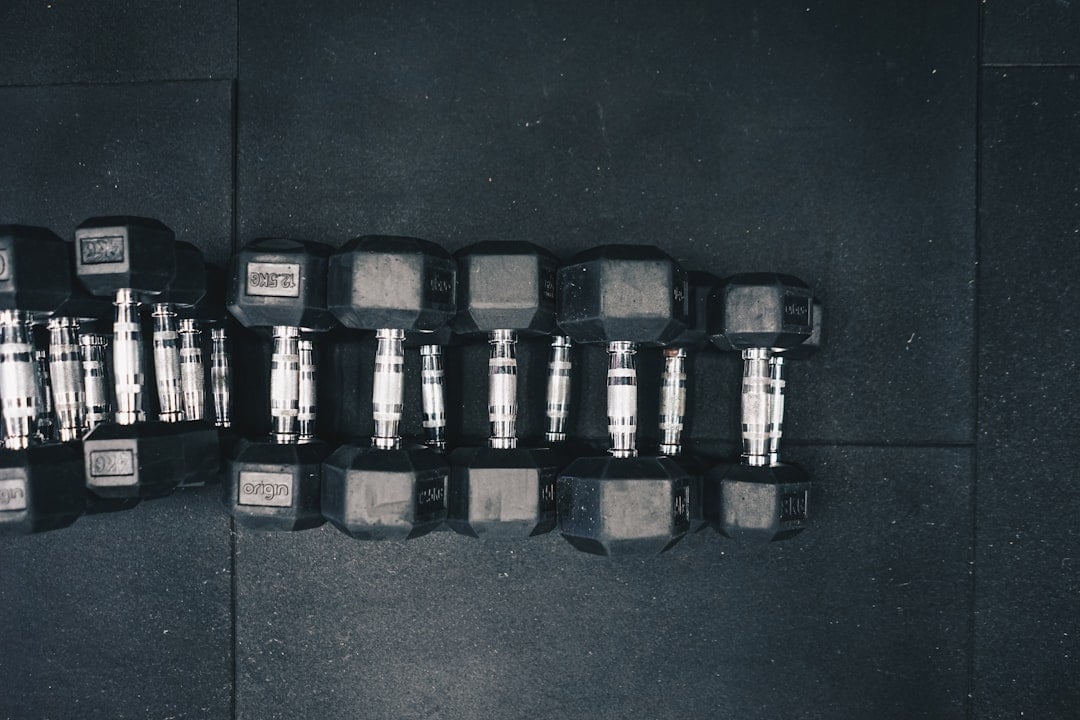
The order determines how much impact energy the room will ever have to handle. Bumper plates and a deadlift zone commit the operator to a structural problem; a plate-loaded and selectorized mix does not, which is why gym noise control belongs in the programming conversation.
That is a programming decision before it is an acoustic one, and it sits alongside membership mix and floor layout.
On an upper floor or above an occupied tenancy, it is the single most consequential line on the order.
Noise Risk by Equipment Class, Graded
The grading below is what we would use during a site selection review. Red items are the ones that make gym noise control a structural project rather than a finishes project.
| Equipment class | Dominant path | Grade | Mitigation that works |
|---|---|---|---|
| Bumper plate deadlift zone | Structure-borne impact | Red | Isolated platform on resilient pads, fully decoupled |
| Heavy dumbbell drops | Structure-borne impact | Red | Dedicated drop zone with a layered subfloor build-up |
| Sled and turf work | Low-frequency structure-borne | Amber | Resilient underlay and a weight limit on upper floors |
| Selectorized stacks | Airborne plus structure-borne | Amber | Stack dampers and maintained end-of-travel bumpers |
| Treadmills | Structure-borne vibration | Amber | Isolation feet, level slab, belt tension program |
| Group cycle studio | Airborne music plus vibration | Amber | Room isolation and a limiter on the sound system |
| Rowers and ski trainers | Airborne fan noise | Green | Separation distance and absorption |
| Pilates reformers | Airborne carriage stop | Green | Carriage bumpers replaced on schedule |
A Gym Noise Control Retrofit in Five Steps
If the letter has already arrived, the sequence below is the fastest route to a defensible position without closing the floor first.
- Measure in the receiving space before you buy anything. The reading that matters is the one at the complainant’s position at the hour they complain, not the one on your own floor.
- Separate the two noise paths. Establish how much of the problem is airborne and how much is structural, because the two have almost no remedies in common.
- Relocate before you rebuild. Moving the drop zone to a slab-on-grade bay or an interior column line often achieves more than any product, at no capital cost.
- Isolate the source, not the room. One properly decoupled platform beats a whole floor of thicker tile, and it can be installed in a single closed day.
- Write the house rules and enforce them. Drop policies during specified hours are the cheapest control available and the one landlords accept as good faith.
What the Occupational Limits Tell You
Operators frequently ask for a legal decibel number. The published limits are occupational, covering staff exposure rather than what a neighboring tenant hears, so they answer a different question than the one being asked.
They are still useful as a floor-level sanity check. NIOSH sets a recommended exposure limit of 85 dBA averaged over an eight-hour workday and treats noise as hazardous at 85 dBA or higher, noting that a sound 10 dB louder than another is ten times more intense.
OSHA’s occupational noise standard sets an eight-hour permissible exposure limit of 90 dBA, an action level of 85 dBA as an eight-hour time-weighted average, and states that exposure to impulsive or impact noise should not exceed 140 dB peak sound pressure level.
Nuisance and lease thresholds are set locally instead, and they vary by jurisdiction and by lease, so gym noise control obligations have to be read from the document rather than from a national standard.
Questions Operators Ask About Gym Noise Control
Will thicker rubber flooring fix our noise complaint
Rarely, if the complaint concerns impact from dropped weights. Thicker rubber of the same construction improves surface protection and does comparatively little for low-frequency energy entering the slab. An isolated platform that decouples the drop point from the structure addresses the actual path, usually for less money than recovering an entire floor.
What noise level are we legally allowed to make
There is no single national figure. Published federal limits govern employee exposure, not transmission to neighbors, while the enforceable threshold in a dispute is normally a municipal ordinance or the nuisance clause in your lease. Read the lease first, then the local ordinance, then commission measurements against whichever is stricter.
Can we keep free weights on an upper floor
Often yes, with constraints. Position the drop zone over a column line rather than mid-span, isolate the platform, cap the loads permitted for dropping, and restrict dropping outside agreed hours. Layout matters as much as product here, as our piece on where congestion and conflict start on a floor plan sets out.
The Decision Was Made at Order Entry
By the time a landlord writes, the operator is choosing among expensive remedies for a problem that cost nothing to avoid at specification. The useful moment is the day the equipment list is signed, when the drop zone either exists or does not, and when an isolated platform is still a line item rather than a construction project. Ask the acoustic question while the order is still a draft.